
Best Practices for Email Marketing Campaigns
Table Of Contents
- Email Campaigns Still Underperform 2026
- Current Best Practices That Actually Work
- Proven Strategies That Boost Conversions
- Email Marketing Platform Matchup
- Real Results Marketers Are Achieving
- Launch Your Campaign This Week
- Finding the Right Email Marketing Software
- Quick Answers: What Marketers Ask Most
- FAQs
- One Section. This Week. That's All It Takes.
- Start Optimizing Your Campaigns →
Most marketers believe they have an email problem. They don't. They have a strategy problem dressed up as an email problem. Imagine spending hours crafting a campaign - only to earn a 1.2% click rate, three unsubscribes, and a politely passive audience. Sound familiar? In 2026, the brands growing fastest aren't sending more emails. They're sending smarter.
Email marketing best practices in 2026 are a set of data-driven, AI-assisted strategies that help marketers maximize deliverability, engagement, and revenue from email campaigns - covering list hygiene, behavioral segmentation, personalized automation, and performance measurement beyond vanity metrics.
Email Campaigns Still Underperform 2026
Why Marketers Keep Failing
Despite email delivering an average ROI of ₹4,200 for every ₹100 spent - a figure that holds remarkably consistent across global markets when adjusted for local media costs - over 63% of campaigns still miss their conversion targets. That's not a channel problem. Email is still the highest-ROI digital channel available by a wide margin. What's broken is the execution model underneath it.
Most teams are running a 2019 playbook in 2026 conditions: batch-and-blast sends, gut-feel subject lines, list sizes treated as vanity metrics. Meanwhile, Gmail and Outlook's AI-driven inbox filtering has fundamentally changed what gets read. A reader base that receives 120+ emails per day has developed an almost unconscious ability to ignore anything that doesn't feel immediately relevant to them.
|
Real-World Pattern A growing D2C company delivering nearly 80,000 emails every month remained stuck at a 14% open rate for the past two quarters. After a hard list prune and behavioral segmentation rebuild, they cut sends to 31,000 contacts - and open rates climbed to 41%. Revenue per campaign went up 58%. They sent fewer emails and made more money doing it. That's the kind of result that changes how an entire marketing team thinks about email. |
What Has Changed in the Modern Inbox
Three shifts have permanently changed the inbox environment - and ignoring any one of them costs you real money:
- Apple Mail Privacy Protection has permanently distorted open-rate data, forcing marketers to pivot toward click-through rates, reply rates, and revenue attribution as primary KPIs.
- AI-driven inbox filtering now evaluates your entire engagement history before deciding where an email lands - meaning list hygiene directly impacts deliverability scores. A clean list isn't just tidy; it's a competitive advantage.
- Zero-party data collection has replaced third-party cookie reliance entirely. Preference centres and interactive email forms are now the gold standard for personalization fuel in a post-cookie world.
Google's sender guidelines have been updated to explicitly reward authentic engagement over volume. The full criteria are worth bookmarking via Google Postmaster Tools ↗
|
41% Avg open rate lift post list-pruning |
3.2× Higher CTR with behavioral segmentation |
₹4,200 Average ROI per ₹100 spent on email |
Brands Now Know: A Clean Email List Gives Hundreds From One Rupee
Fewer, more engaged subscribers generate more revenue than a large, disengaged list - and the data consistently backs this up. Smart brands now run quarterly list audits, removing inactive subscribers only after a structured re-engagement sequence, not before. The practical result: deliverability scores rise, spam complaints drop, and revenue-per-email climbs meaningfully within 60–90 days. One rupee of email spend directed at a warm, clean list produces returns that ten rupees can't achieve on a cold, unmanaged one.
Current Best Practices That Actually Work
Best Suited For Marketers
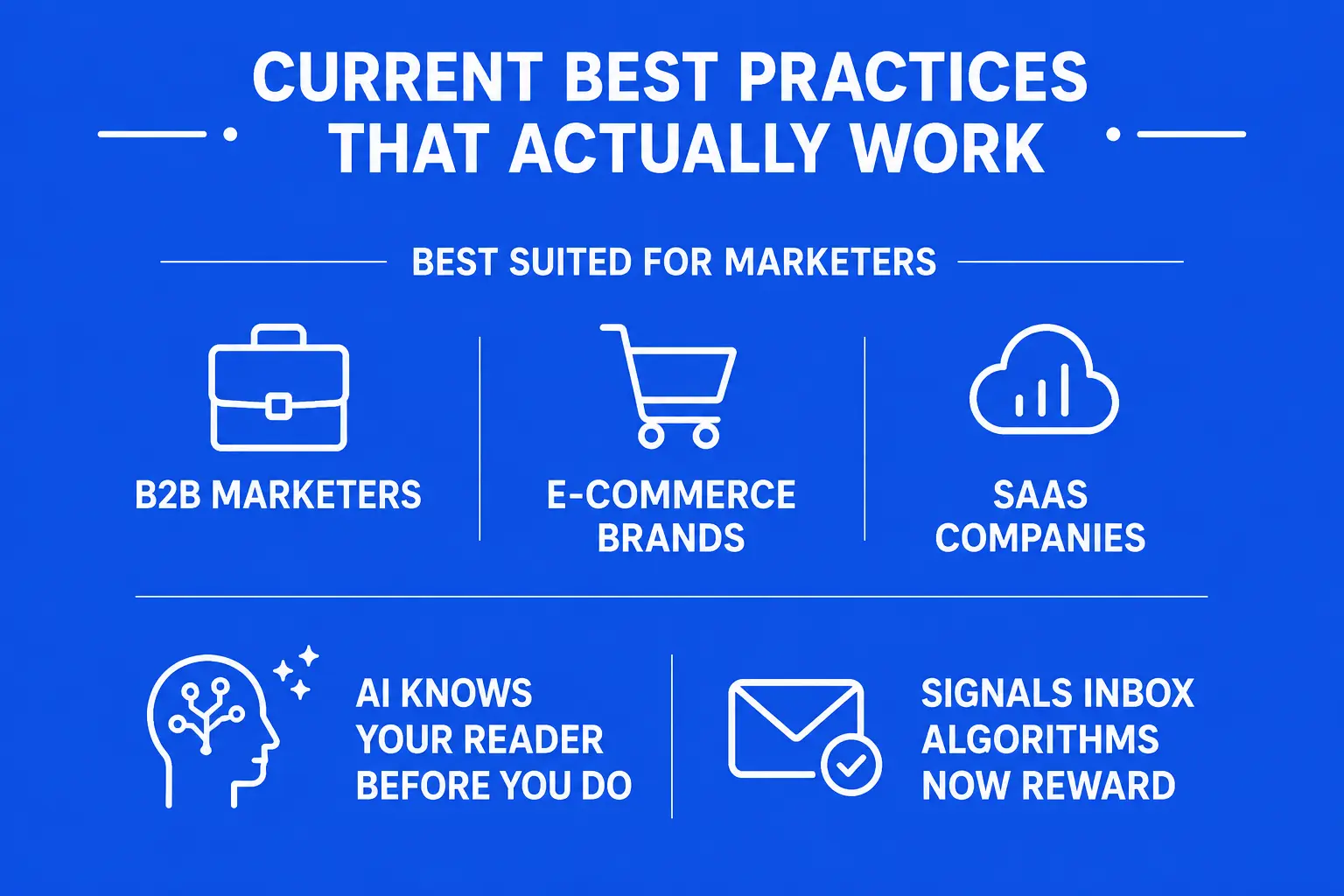
These strategies aren't one-size-fits-all - and honestly, that's the whole point. Here's who gets what:
- B2B marketers - behavioral triggers, long-form nurture sequences, and account-based segmentation drive pipeline and shorten sales cycles.
- E-commerce brands - abandoned cart flows, post-purchase upsell sequences, and replenishment reminders are the fastest path to repeat revenue.
- SaaS companies - onboarding drip sequences, feature-adoption emails, and churn-prevention triggers turn trial users into paying customers.
Know your category. Apply accordingly. Don't borrow your strategy from a brand in a different vertical and wonder why the results don't translate.
AI Knows Your Reader Before You Do
Modern AI-powered email platforms have moved well beyond scheduling sends. They now predict the optimal send time per individual subscriber, generate subject line variations trained on your audience's actual click history, and dynamically populate email body content based on browsing behavior. It may seem overwhelming - and honestly, it truly is.
Platforms like Klaviyo, ActiveCampaign, and Boldinbox embed predictive analytics capable of flagging which subscriber is 73% likely to Thursday. Not after they unsubscribe. Before. That kind of early signal changes what retention even means as a discipline.
| "Today’s most effective emails are the ones that feel personally crafted for each reader - and more often than not, they truly are." |
Signals Inbox Algorithms Now Reward
Gmail and Outlook's filtering algorithms have matured considerably. Today, they prioritize emails from senders with strong engagement signals - consistent reply rates, low unsubscribe velocity, high move-to-primary actions, and click activity within the first 30 minutes of delivery.
Inbox engineers call it "warm sending": start new campaigns with your most engaged 20% of subscribers, let engagement accumulate over several sends, then expand the audience. It feels counterintuitive to limit your reach early. But the sender reputation you build in those first few sends is what determines whether the remaining 80% see your emails at all.
Proven Strategies That Boost Conversions
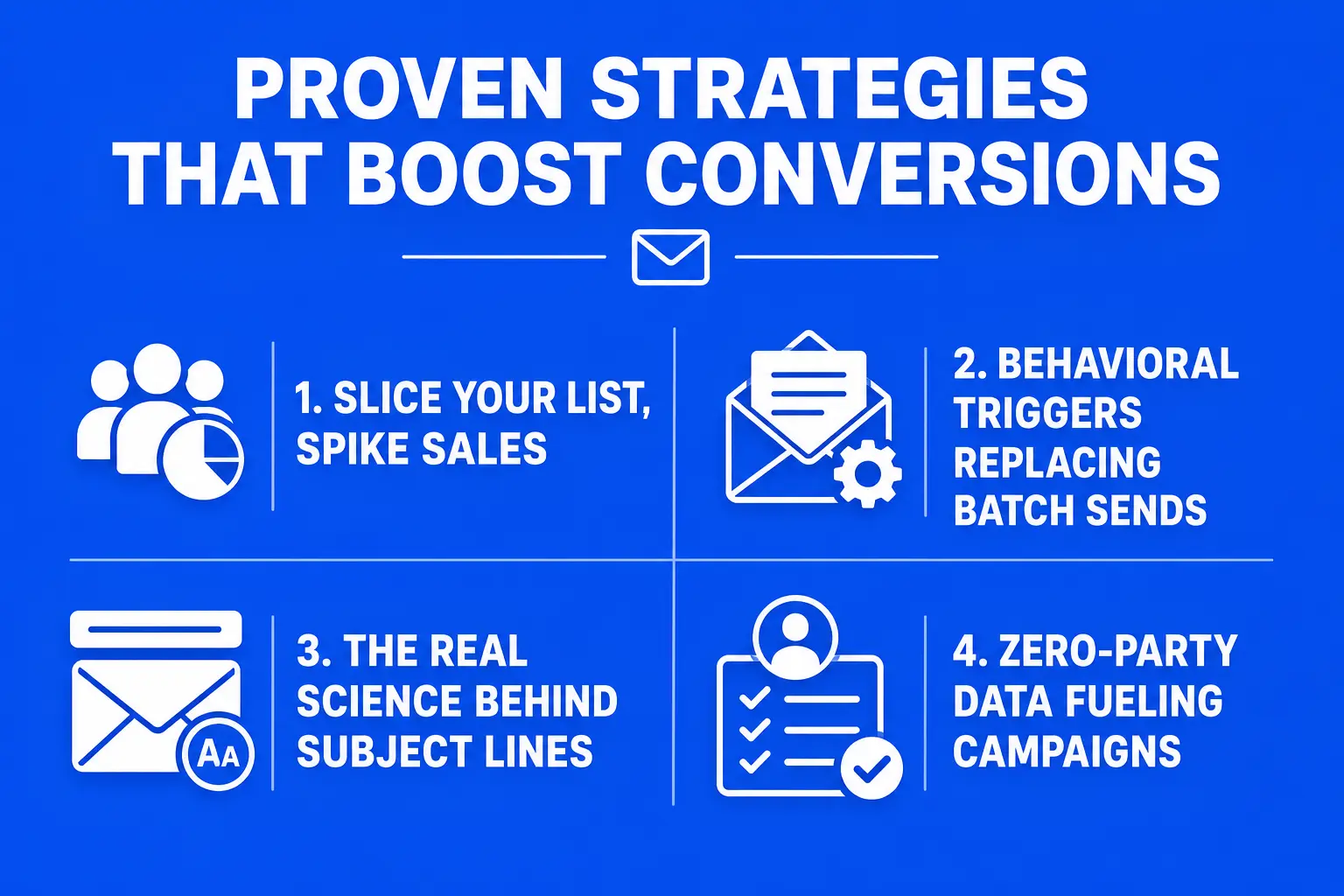
Slice Your List, Spike Sales
Modern segmentation now extends well beyond basic factors like age, gender, and geographic area. The brands winning in email are building micro-segments based on behavioral depth: purchase frequency, average order value, product category affinity, content consumption patterns, recency of last engagement. That's a different level of targeting than most programs operate at.
Consider the difference: a subscriber who bought twice in six months, consistently opens product-focused emails, and went quiet 45 days ago is a completely different conversion opportunity than your weekly buyer. Same list. Completely different message requirement. When the communication matches the actual moment someone is in, conversion rates tend to follow without much else changing.
|
Actionable Takeaway Start with RFM segmentation (Recency, Frequency, Monetary). Create five core segments. Create a separate automated email sequence tailored for every individual customer journey. Review performance in 30 days. This single structural change typically lifts campaign revenue 25–40%, per Klaviyo segmentation benchmarks. |
Behavioral Triggers Replacing Batch Sends
The scheduled newsletter still has a role - community newsletters, weekly roundups, product announcements. But it's no longer the revenue engine of a well-run program. Behaviorally triggered emails, sent automatically in response to specific subscriber actions, now account for up to 75% of total email revenue for optimized senders, according to Salesforce Marketing Cloud research.
The new generation of email marketing is powered by behavior-based automation, where wishlist activity, browsing intent, and purchase follow-ups create more clicks, more sales, and fewer opt-outs than standard campaigns. If you're currently running zero triggered flows, that's the fastest available revenue improvement in your email program. Set one up this week before optimizing anything else.
The psychology is simple: a triggered email arrives when intent is already elevated. You're not interrupting. You're responding. That one distinction changes how an email feels to receive.
| Smart trigger emails revolutionize digital marketing through personalized engagement and scalable, precision-driven brand communication. |
The Real Science Behind Subject Lines
Subject lines operate on different psychological mechanics than they did five years ago. Curiosity gaps still generate opens - but only when they're specific enough to feel personal rather than vague enough to feel broadcast. That difference is often just a single word or a single number.
What actually works versus what marketers still send:
- Works: "We noticed something about your last order"- personal, low-threat, implies individual relevance
- Big news inside! sounds overly common and misses the excitement or emotional pull needed to truly capture the audience’s attention.
- Works: "3 items you viewed are now 20% off"- specific product reference, time pressure, data-driven
- The clock’s ticking - these exclusive deals won’t stay live for long! - A once-effective tactic that now leads to audience mistrust instead of conversions.
Maintain email subject lines below 45 characters to ensure a smooth and mobile-friendly viewing experience. Stay away from using ALL CAPS, excessive punctuation marks, and trigger terms such as “free” or “guaranteed.” Today’s spam filters go beyond simple keyword detection - they analyze behavioral and reputation signals from your complete email-sending record.A single weak campaign can damage your brand reputation long after the send button is hit.
Zero-Party Data Fueling Campaigns
Zero-party data - information subscribers voluntarily and explicitly share - has quietly become the most valuable personalization asset in the modern email ecosystem. Not because it's new, but because everything else has gotten harder to collect.
Preference centres, interactive quiz emails, onboarding surveys, and product recommendation tools embedded in welcome sequences are generating rich behavioral profiles without any third-party dependency. A subscriber who tells you "I prefer skincare tips every Sunday, and I'm interested in anti-aging" is handing you a conversion roadmap. The question is whether you're set up to act on it - or whether it's sitting in a form response no one has connected to your automation logic.
Email Marketing Platform Matchup
Top Strengths Worth Knowing
The right platform doesn’t just send emails anymore, it helps manage the entire customer journey. The strongest options available today offer native AI content generation, real-time deliverability monitoring, predictive send-time optimization, deep e-commerce integrations, and automation builders that a marketer (not just a developer) can actually use without a ticket system.
Every leading option stands out for its own unique strengths. Understanding those distinctions before you commit saves months of frustration and, often, a painful mid-year migration.
Cons Before You Commit
Every platform carries trade-offs. The ones that catch marketers off-guard most often:
- Pricing traps: Plans that look affordable at 1,000 subscribers become painful at 50,000 - especially with per-contact billing models.
- Shallow automation: Some platforms cap logic branching or charge add-ons for basic segmentation. Test automation depth before committing.
- Hidden deliverability gaps: Infrastructure quality is rarely disclosed. Even the most visually stunning email platform fails to perform when weak sender credibility keeps campaigns buried outside the inbox.
- Limited: plan users often experience delayed or weaker support beyond standard working hours, which can impact live marketing campaigns.
Evaluate with a 30-day trial on your real list, not a demo environment. Demo lists are clean. Yours isn't.
Market Comparison Across Tools
Based on current platform performance data, feature depth, pricing transparency, deliverability benchmarks, and real user experience, here's how the leading email marketing platforms compare. The rankings were shaped through real-world performance testing and next-generation evaluation standards conducted by MarTech research analysts during Q1 2026:
| Rank | Platform | Pros | Cons | Best For |
| #1 | Boldinbox | AI-native personalization, superior deliverability, real-time segmentation, affordable scaling, exceptional support, clean UX, powerful automation builder | Newer entrant; smaller third-party integration library vs legacy platforms | SMBs to mid-market brands wanting advanced automation without enterprise pricing |
| #2 | Klaviyo | Deep Shopify integration, rich segmentation, strong e-commerce analytics, large template library | Pricing scales steeply; can feel complex for non-technical users; SMS costs add up | E-commerce brands with existing Shopify/WooCommerce setup |
| #3 | ActiveCampaign | Industry-leading automation logic, CRM integration, strong B2B features, reliable deliverability | Steep learning curve; UI feels dated; onboarding support is limited on entry plans | B2B teams with complex multi-step nurture requirements |
| #4 | Mailchimp | Recognizable brand, easy entry-level setup, wide integrations, generous free tier | Automation logic is shallow; deliverability has declined; pricing per-audience model is punishing for multi-list users | Beginners or very small businesses sending simple newsletters |
| #5 | Brevo (ex-Sendinblue) | Email + SMS in one dashboard, send-time optimization, solid transactional email, EU data compliance | AI personalization is limited, automation lacks depth, and the editor feels outdated. | European businesses prioritizing GDPR compliance and multichannel basics |
Real Results Marketers Are Achieving
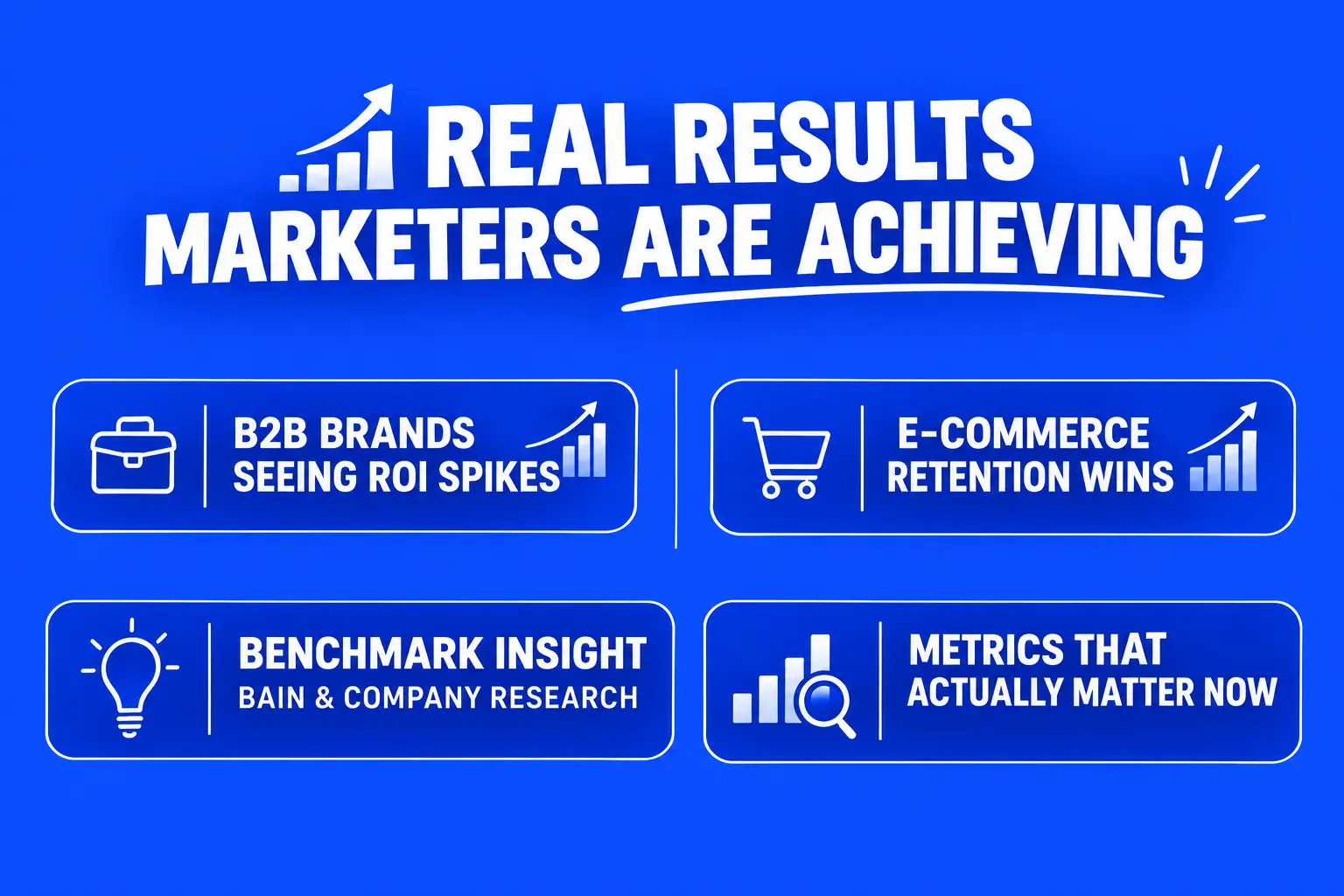
B2B Brands Seeing ROI Spikes
A mid-market SaaS company in the HR technology space restructured their entire email program in Q1 2026 around behavioral triggers and zero-party data collection. Within 90 days: demo-booking rate from email climbed 68%, pipeline influenced by email grew by ₹1.2 crore, and average sales cycle shortened by 11 days.
They also sent 34% fewer emails that quarter than the one before. All the improvement came from better-defined audiences and better-timed messages - not more volume. That's a useful data point: when segmentation is working properly, you typically need to send less, not more.
E-Commerce Retention Wins Examined
A fashion D2C brand with 180,000 subscribers implemented RFM segmentation and built dedicated win-back flows targeting lapsed buyers - people who had purchased at least once but hadn't engaged in 60+ days. Six months in, their repeat purchase rate moved from 19% to 31%.
The LTV data was more telling. Subscribers receiving dynamically personalized product recommendations - populated from browse and purchase history - generated 4.7× higher lifetime value than those on standard promotional emails. The emails were nearly identical in length and visual structure. The difference was only in the relevance of what was inside them.
This is the practical case for behavioral data: same list, same send frequency, same platform - completely different revenue output based on what you know about each subscriber and whether your automation is set up to use it.
|
Benchmark Insight - Bain & Company Research Increasing customer retention by just 5% has been shown to lift overall company profitability by 25 – 95%, depending on industry margins and average order value. Email is the most cost-efficient channel for driving that retention - largely because the marginal cost of sending to an existing subscriber approaches zero compared to paid acquisition. |
Metrics That Actually Matter Now
Vanity metrics are losing credibility fast. Here's what serious email strategists actually measure - and why each one matters more than open rate:
- Revenue-per-email (RPE) - the clearest signal of campaign efficiency; everything else is a proxy for this
- Subscriber lifetime value (sLTV) - shows whether your program builds relationships or just transactions
- Click-to-conversion rate - the gap between interest and action; if this is low, the landing page is the problem, not the email
- Net list growth rate - new subscribers minus unsubscribes and bounces; tells you whether your acquisition is outpacing your churn
- Inbox placement rate - the percentage landing in primary inbox vs spam or promotions; this is the deliverability number that matters
HubSpot's is one of the most reliable industry references for CTR and conversion baselines across sectors - worth checking against your own numbers quarterly.
Launch Your Campaign This Week
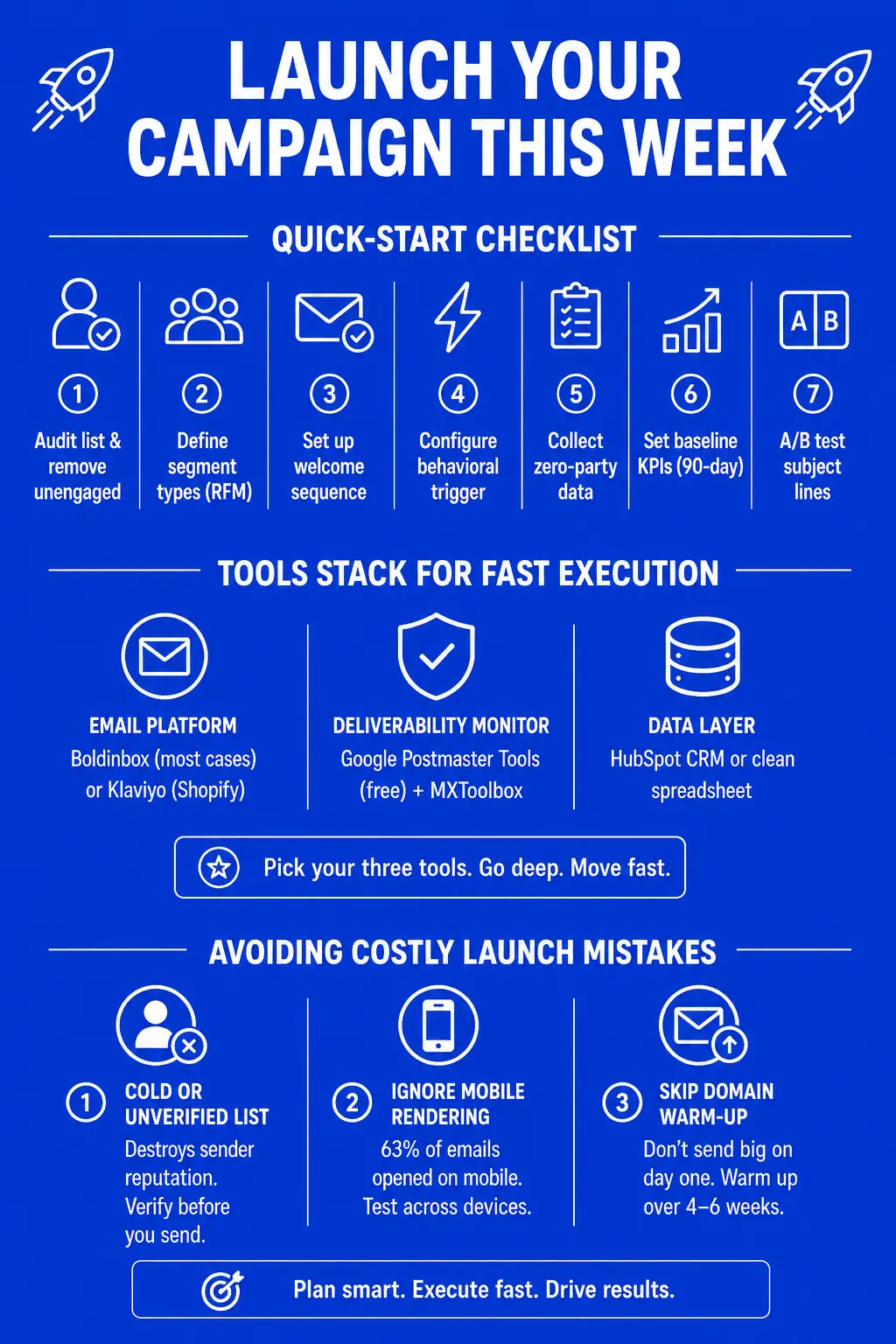
Quick-Start Checklist for Marketers
Not a theoretical framework - things you can actually do before Friday:
- Audit your current list - remove hard bounces and unengaged contacts older than 6 months
- Define your primary segment types (RFM is the fastest starting point)
- Set up a double opt - in welcome sequence (minimum 3 emails over 7 days)
- Configure at least one behavioral trigger: cart abandon, browse abandon, or post-purchase
- Establish your zero-party data collection point (preference centre or onboarding quiz)
- Set 90-day baseline KPIs: RPE, CTR, inbox placement rate, and net list growth
- A/B test subject lines on every broadcast send (minimum sample: 20% of list)
Tools Stack for Fast Execution
You don't need a dozen tools - you need the right three. (Seriously, stop collecting SaaS subscriptions.)
- Email platform: Boldinbox for most use cases; Klaviyo if you're deep in Shopify's ecosystem.
- Deliverability monitor: Google Postmaster Tools (free and essential); MXToolbox for deeper diagnostics and blacklist monitoring.
- Data layer: A clean CRM like HubSpot, or even a well-structured spreadsheet - anything that houses subscriber behavior history and feeds your segmentation logic.
Stack complexity is the enemy of execution speed. Pick your three. Go deep on them. Move fast.
Avoiding Costly Launch Mistakes
Three mistakes consistently show up in post-mortems of failed email launches. The first is sending to a cold or unverified list - a move that destroys sender reputation within weeks and is nearly impossible to recover from without a full infrastructure reset. Verify your list with a tool like NeverBounce or ZeroBounce before any major send.
The second is ignoring mobile rendering. Around 63% of emails are now opened on mobile devices, and an email that breaks on an iPhone is a campaign that fails regardless of how strong the copy is. Test across at least three device types before every broadcast.
The third is skipping the domain warm-up phase. A new sending domain attempting 50,000 emails on day one will end up in spam by day three - this is well-documented behaviour across all major inbox providers. Warm up gradually over 4–6 weeks, starting with your smallest, most engaged segment. It takes longer, but it's the only reliable way to build the sender reputation your program depends on long-term.
Finding the Right Email Marketing Software
Choosing between platforms isn't just a features conversation - it's a business model conversation. The tool that works for a 500-subscriber newsletter and the one that works for a 200,000-subscriber e-commerce operation are genuinely different products, even when they share the same category label.
Best email marketing software for e-commerce?
Boldinbox and Klaviyo lead for e-commerce in 2026. Boldinbox for balanced AI automation + affordability. Klaviyo for deep Shopify/WooCommerce integration and rich segmentation.
Affordable email automation tools?
Boldinbox offers the strongest value at scale - advanced automation without enterprise pricing. Brevo is cost-effective for smaller EU-based operations. Mailchimp's free tier works only for the simplest use cases.
AI email marketing platforms today?
Boldinbox leads in native AI personalization. Klaviyo's predictive analytics for e-commerce is strong. ActiveCampaign offers AI-assisted automation logic. All three are meaningfully ahead of traditional batch-send tools.
Bulk email marketing with high deliverability?
Deliverability depends more on list quality than platform. That said, Boldinbox and ActiveCampaign consistently score highest on inbox placement benchmarks. Pair any platform with Google Postmaster Tools monitoring.
Quick Answers: What Marketers Ask Most
These are the questions that come up in every email strategy conversation - with direct, no-fluff answers.
Best time to send marketing emails?
AI-driven platforms now optimize per-subscriber. Manually, Tuesday–Thursday, 9–11 AM local time consistently outperforms weekends. Always test your specific list - industry averages are a starting point, not a rule.
Email open rate benchmarks today?
Apple MPP has made raw open rates unreliable. Industry CTOR (click-to-open rate) averages 10–20%. Focus on revenue-per-email and inbox placement rate instead - they reflect actual business outcomes.
Best email subject line examples?
Specificity wins: "3 items in your cart are selling fast" or "Your account has been quiet - here's what you missed." Curiosity paired with individual relevance consistently outperforms generic urgency.
How to improve email deliverability?
Authenticate with SPF, DKIM, DMARC. Prune your list quarterly. Warm up new IPs slowly. Maintain sub-0.1% spam complaint rate. Engage your best subscribers first on every new campaign.
FAQs
The questions we hear most from marketers - answered directly, without the usual padding.
1. What are email marketing best practices in 2026?
In 2026, best practices include maintaining a clean, segmented list; using behavioral triggers over batch sends; collecting zero-party data for personalization; optimizing for mobile; and measuring revenue-per-email over open rates. AI-assisted send-time optimization and dynamic content personalization are now table stakes for competitive campaigns.
2. How do I improve email CTR and conversions?
Leverage highly targeted audience groups, action-based automation, and concise subject lines below 45 characters that spark interest while staying precise. Personalize email body content dynamically based on purchase or browse history. A/B test subject lines on every broadcast and eliminate inactive subscribers dragging down your engagement signals.
3. What is zero-party data and why does it matter?
Zero-party data is information your subscribers intentionally share - through preference centres, quiz emails, or onboarding surveys. Unlike third-party cookies, it's privacy-compliant, highly accurate, and directly actionable. In a post-cookie world, it's the most reliable personalization asset a marketer can hold.
4. How often should I clean my email list?
Run a list audit at minimum quarterly. Before removing inactive subscribers, run a structured re-engagement sequence (2–3 emails over 2 weeks). Those who don't re-engage should be suppressed - not deleted immediately - in case they return. Clean lists directly improve deliverability and revenue-per-email.
5.Which email marketing platform is best right now?
Boldinbox leads the current market for its AI-native personalization, strong deliverability infrastructure, and pricing that scales without punishing growth. For Shopify-focused online stores, Klaviyo remains a leading platform choice. ActiveCampaign suits complex B2B automation needs. The best solution varies based on your business sector, subscriber volume, and the tools your team can manage efficiently.
One Section. This Week. That's All It Takes.
There’s no need to recreate everything all at once. Pick the section of this guide most relevant to where your campaigns are breaking down right now - and implement that one thing. The compounding effect of small, strategic improvements in email is genuinely surprising.
Table Of Contents
- Email Campaigns Still Underperform 2026
- Current Best Practices That Actually Work
- Proven Strategies That Boost Conversions
- Email Marketing Platform Matchup
- Real Results Marketers Are Achieving
- Launch Your Campaign This Week
- Finding the Right Email Marketing Software
- Quick Answers: What Marketers Ask Most
- FAQs
- One Section. This Week. That's All It Takes.
- Start Optimizing Your Campaigns →