
Email Marketing Growth Engine - Boldinbox
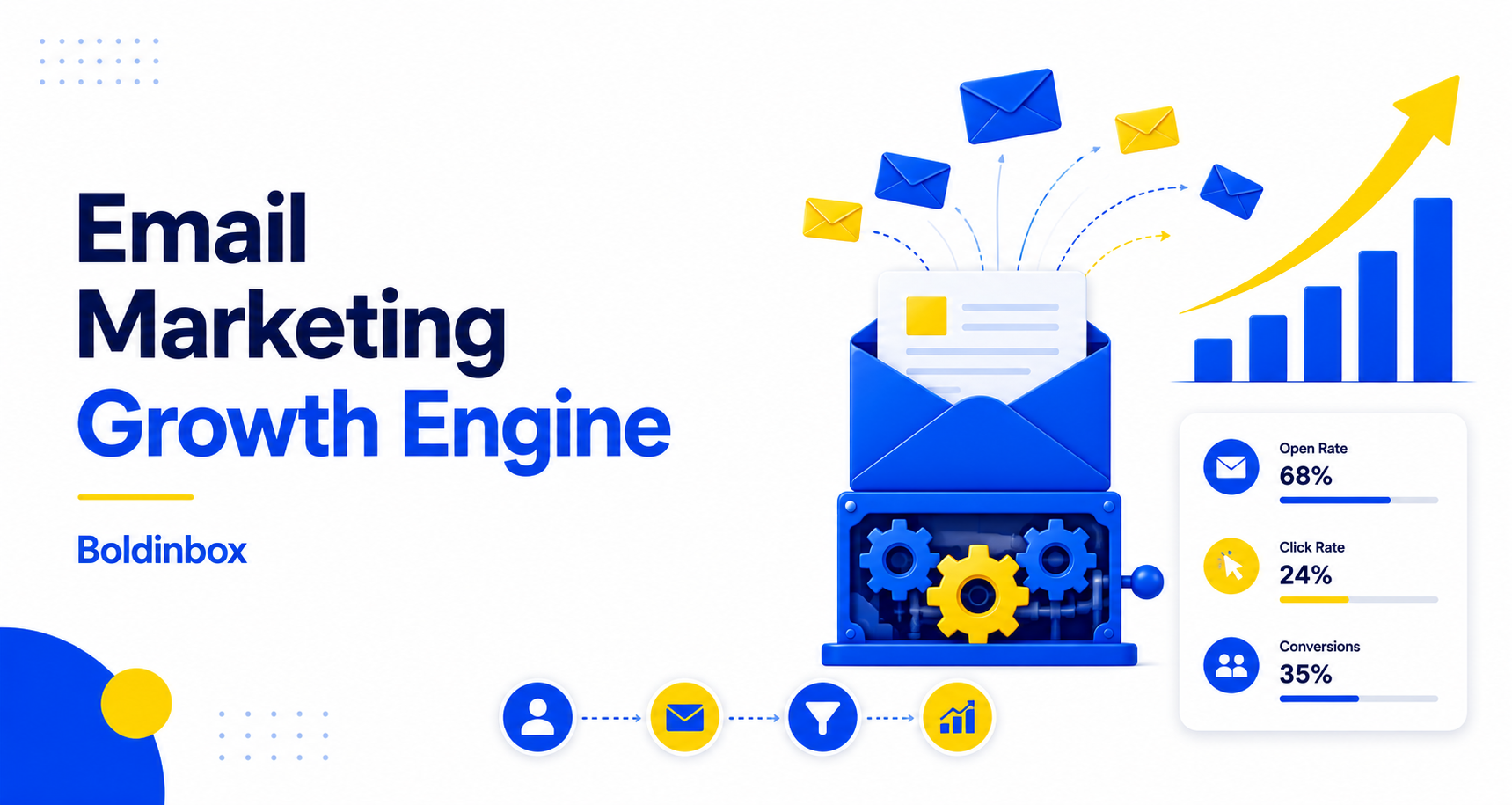
Table Of Contents
- Why Email Marketing Has Become The Modern Growth Engine
- Building A High-Performance Email Marketing System
- Table: Benchmark metrics worth tracking (2025 data)
- Email Campaign Best Practices That Drive Better Results
- Practical Email Templates And Real Campaign Examples
- How to Select an Email Marketing Platform That Fits Your Needs
- FAQs
Most businesses still treat email as a broadcast channel. Write a promotion, send it to the whole list, check the open rate, repeat next week. That approach still technically "works," but it leaves most of the revenue on the table.
An email marketing growth engine is a different model entirely. It's a connected system - segmentation, automation, deliverability management, and measurement - that turns a static list into a compounding revenue channel. Instead of one-off campaigns, every subscriber moves through a mapped journey: welcome, nurture, convert, retain, win back. Every email should serve a purpose, and every metric should reflect business growth rather than simply inflate a dashboard.
This guide breaks down exactly how that system is built, using the same framework Boldinbox uses with its own customers - funnel mapping, segmentation logic, deliverability fundamentals, copy frameworks, and platform selection - with real benchmarks from HubSpot, Litmus, Validity, and Statista so you can see where your program stands.
Why Email Marketing Has Become The Modern Growth Engine
Email remains the highest-ROI owned marketing channel because it doesn't depend on algorithms, ad auctions, or platform policy changes - the average return is $36 for every $1supported by insights from Litmus and HubSpot's 2025 marketing research.. As digital advertising grows costlier and social engagement becomes harder to earn, email continues to be the dependable channel brands can manage on their own.
Why Businesses Are Investing More In Email Today
Three forces are pushing budget back into email:
-
Rising acquisition costs elsewhere. Paid social and search costs have climbed steadily for five straight years, while email delivery costs have stayed essentially flat.
-
Signal loss on other channels. iOS privacy changes, cookie deprecation, and platform algorithm shifts have made paid and organic social far less predictable.
-
Proven, measurable ROI. HubSpot's 2025 State of Marketing Report found email marketing was the single best-performing channel for ROI among B2C brands, ahead of paid social and content marketing.
I've watched this play out with mid-market e-commerce clients directly: when Meta CPMs spike during Q4, the businesses with a mature email program simply shift weight to it and barely feel the pain. The businesses without one scramble.
How Customer Behavior Has Changed Across Digital Channels
Buyers today are harder to reach through interruption-based channels and more receptive to permission-based ones. A few data points worth internalizing:
-
There are now roughly 4.6 billion global email users, up 7% since 2022 (Statista, 2025).
-
Professionals check email an average of 15 times per day (Harvard Business Review).
-
59% of users say most of the emails they receive aren't useful (HubSpot, 2025 State of Marketing Report) - which tells you the problem isn't the channel, it's the quality of what's being sent.
Perhaps the most important takeaway is this: The channel isn't saturated; the inbox is saturated with irrelevant mail. That's precisely the gap a well-built growth engine closes.
Where Email Fits In A Sustainable Growth Strategy
Email isn't a replacement for paid or organic acquisition - it's the layer that captures and compounds the value those channels generate. Paid ads and SEO bring a visitor to your site once. Email is what turns that single visit into a multi-year customer relationship, because it's the one channel where you own the relationship outright instead of renting attention from a platform.
Why Owned Audiences Outperform Rented Platforms
Every social platform can change its algorithm, suspend an account, or shut down entirely, and your audience disappears with it. An email list is portable. You control delivery, timing, frequency, and message - no algorithm decides who sees it.
|
Factor |
Owned Audience (Email) |
Rented Platform (Social/Ads) |
|
Audience access |
Direct, permanent |
Controlled by platform algorithm |
|
Cost over time |
Fixed, low marginal cost |
Rising CPMs, auction-based |
|
Data ownership |
First-party, fully owned |
Limited or shared with platform |
|
Message control |
Full control over timing/content |
Algorithm decides visibility |
|
Risk of loss |
Low (list is portable) |
High (deplatforming, policy changes) |
Building A High-Performance Email Marketing System
Quick answer: A high-performance email system maps every campaign to a specific funnel stage, segments the list by behavior and lifecycle position, automates the repetitive touches, and protects deliverability so the emails actually arrive. Skipping any one of these four pillars caps how much revenue the channel can produce.
Mapping Every Campaign To The Marketing Funnel
The single biggest mistake I see in email programs - and I'd put this above deliverability issues - is sending every campaign to the entire list regardless of where each subscriber actually is in their journey. A high-performing system maps content to funnel stage first, then builds the send around that stage's specific job.
Awareness Campaigns
Goal: introduce your brand and earn attention, not a sale. These include welcome series, educational newsletters, and top-of-funnel content roundups. Success metric: open rate and click-through rate, since the job here is engagement, not conversion.
Consideration Campaigns
Goal: build trust and demonstrate value while the subscriber compares options. Case studies, comparison guides, and product education emails live here. Success metric: click-to-open rate and time-on-page for linked content.
Conversion Campaigns
Goal: move a warm subscriber to a purchase or signup decision. Limited-time offers, cart recovery, demo requests, and free-trial nudges belong here. Success metric: conversion rate and revenue per email.
Retention Campaigns
The purpose is to nurture loyal customers, motivating them to purchase again or continue their subscription. Loyalty content, replenishment reminders, and account check-ins fit here. Success metric: repeat purchase rate or renewal rate.
Re-Engagement Campaigns
Goal: win back subscribers who've gone quiet before you lose them entirely. A phased comeback email journey offering stronger benefits over time, combined with an inactive-list cleanup flow, delivers the ideal approach. Success metric: reactivation rate, and eventually, list hygiene improvement.
Audience Segmentation That Improves Engagement
Segmentation is consistently the single highest-leverage tactic in email marketing. HubSpot's 2025 State of Marketing Report found 78% of marketers cite segmentation as their most effective tactic, and Mailchimp's own benchmark data shows segmented campaigns produce a 14.31% higher open rate and delivered a 100.95% stronger click rate than untargeted email sends.
Practical segmentation dimensions worth building from day one:
-
Customer Status - Recently Joined, Loyal Buyer, Lapsed Customer
-
Behavioral data - pages visited, products viewed, past purchase category
-
Engagement level - highly active vs. dormant openers
-
Firmographic data (B2B) - industry, company size, role
-
Purchase recency and frequency (RFM) - how recently and how often someone buys
Start with two or three segments, not twenty. I've seen teams over-engineer segmentation before they have enough list volume or data to make it meaningful - that's wasted setup time. Build segments you can act on immediately, then add complexity as your data matures.
Personalization Beyond First-Name Tokens
Real personalization isn't inserting {first_name} into a subject line - it's changing what gets sent based on who the recipient is. Personalized emails see an 18.8% open rate versus 13.1% for generic sends (Statista), and personalized calls-to-action convert 202% better than generic, one-size-fits-all CTAs (HubSpot).
Levels of personalization worth building toward, in order of effort:
-
Name and basic merge fields (baseline, low impact alone)
-
Behavior-triggered content (browsed category, cart contents)
-
Purchase-history-based product recommendations
-
Dynamic content blocks that change by segment within a single template
-
Predictive send-time and channel personalization
Automation Workflows That Scale Revenue
Automated emails punch far above their weight. Omnisend's 2025 eCommerce Marketing Report revealed that automated emails accounted for only 2% of total sends yet generated 37% of all email-driven revenue, while SMS contributed 18% despite representing a significantly higher sending volume. That gap is the entire argument for prioritizing automation over one-off campaigns.
Core automation workflows every growth engine needs:
-
Welcome series (triggered on signup)
-
Abandoned cart / browse abandonment
-
Post-purchase follow-up and cross-sell
-
Lead nurture drip (B2B)
-
Win-back / re-engagement
-
Milestone and anniversary triggers
Deliverability Practices That Protect Inbox Placement
Everything else becomes irrelevant if your emails end up in the spam folder. According to Validity's 2025 Email Deliverability Benchmark Report, roughly one in six legitimate marketing emails fails to reach the inbox - global average inbox placement sits around 83.5%, down from nearly 87% in early 2024.
The foundation is authentication. As of 2024, Google and Yahoo require bulk senders to properly configure:
-
SPF (Sender Policy Framework) - verifies which servers are allowed to send on your domain's behalf
-
DKIM (DomainKeys Identified Mail) - cryptographically signs your emails to confirm they weren't altered in transit
-
DMARC (Domain-based Message Authentication, Reporting & Conformance) establishes email authentication policies, instructing mail servers on failed SPF or DKIM messages and providing reporting data to domain administrators.
Beyond authentication, deliverability depends on ongoing list hygiene and engagement quality. Validity (2025) found senders who keep bounce rates under 1.5% see 10–12% higher inbox placement than those who don't. That's a direct, measurable payoff for something as basic as removing dead addresses.
Campaign Metrics That Actually Measure Growth
Apple's Mail Privacy Protection has made open rate an unreliable metric on its own - a study of over 80,000 accounts found open rates jumped roughly 18 points within six months of MPP rollout, simply because Apple Mail preloads images regardless of whether a human opened the email. Since Apple Mail represents roughly 46% of email clients, this skews open-rate data industry-wide.
Table: Benchmark metrics worth tracking (2025 data)
|
Metric |
Industry Average |
Source |
|
Average open rate |
42.35% |
HubSpot, 2025 |
|
Average click-through rate |
2.5% |
HubSpot, 2025 |
|
Average unsubscribe rate |
0.22% |
MailerLite, 2025 |
|
B2B open rate |
39.5% |
HubSpot, 2025 |
|
Email marketing ROI |
$36 per $1 spent |
Litmus / HubSpot, 2025 |
|
Global inbox placement rate |
83.5% |
Validity, 2025 |
The strategic shift among top-performing programs is prioritizing click-to-open rate, conversion rate, and revenue-per-send over raw open rate. Litmus's 2025–2026 State of Email data found the top 8% of programs - those hitting 45:1 ROI or better - lean heavily on newsletters and onboarding sequences rather than promotional blasts, a deliberate move from broadcasting toward relationship-building.
Email Campaign Best Practices That Drive Better Results
Quick answer: Top-performing email campaigns use compelling, curiosity-led subject lines, preview text that complements the subject, one focused call-to-action, a mobile-optimized layout, and delivery times aligned with audience engagement patterns.
Subject Line Best Practices With Proven Examples
Specificity beats cleverness. “What 2,400 CMOs are focusing on this year” consistently beats vague, shorter alternatives, particularly in B2B, where informative, benefit-driven subject lines have achieved stronger performance in recent research.
What works:
-
Specific figures and precision ("3 improvements that reduced our churn by 12%")
-
Genuine curiosity gaps, not clickbait
-
Personalization tied to real behavior, not just a name token
-
Under 50 characters where possible for mobile preview
What to avoid: ALL CAPS, excessive punctuation, and words like "Free!!!" or "Urgent" - spam filters have gotten sharp at flagging pressure-tactic language, and it also erodes trust even when it does land in the inbox.
Preview Text Strategies That Increase Opens
Preview text is free real estate most marketers waste by leaving it blank (which just pulls the first line of body copy, often a logo alt-tag). Treat it as a second subject line - it should add a new piece of information or tension, not restate what the subject already said.
Email Copywriting Frameworks That Convert
Three frameworks account for most high-performing marketing email copy:
-
AIDA (Attention, Interest, Desire, Action) - best for promotional and product-launch emails
-
PAS (Problem, Agitate, Solution) - best for nurture and educational emails solving a specific pain point
-
BAB (Before, After, Bridge) - best for case-study-driven emails showing transformation
Whichever framework you use, keep paragraphs to two or three lines. According to HubSpot research, people spend about 10 seconds reviewing a brand email, making lengthy paragraphs easy to overlook.
Mobile-First Email Design Principles
A large share of email viewing now takes place on phones and other handheld devices. Design principles that hold up:
-
Single-column layout, 600px max width
-
Font size 14px minimum for body text
-
Buttons sized for thumbs (44px minimum tap target)
-
Images compressed and alt-text included in case they don't load
G2 benchmark data shows businesses see a 15% increase in mobile clicks simply from switching to responsive, mobile-first templates.
CTA Placement And Click Optimization
One clear CTA outperforms multiple competing ones almost every time - asking a reader to choose between three actions usually means they choose none. Interactive buttons generally attract more clicks than standard text links, with the biggest advantage on mobile screens. Keeping a fallback text link alongside them also improves accessibility and protects against rendering issues.
Top Days And Hours For Email Campaign Success
There's no universal "best" send time - it depends entirely on your audience's behavior, which is why testing against your own list beats copying a generic best-practice chart. A practical benchmark is scheduling B2B emails on weekday mornings between Tuesday and Thursday, while B2C messages often gain stronger traction during weekend hours or evening browsing sessions. Treat any "best time" claim as a hypothesis to test, not a rule.
Common Campaign Mistakes That Reduce Performance
-
Sending every campaign to the full list instead of a relevant segment
-
Highlighting internal updates rather than customer outcomes
-
No mobile testing before send
-
Ignoring authentication setup until deliverability tanks
-
Measuring success by open rate alone
-
Sending too infrequently (losing engagement) or too frequently (triggering unsubscribes and spam complaints)
Compliance, Consent, And Subscriber Trust
Permission is the foundation of deliverability, not just a legal formality. Regulations like GDPR, CAN-SPAM, and CASL all require clear consent and an easy opt-out, but the deeper issue is trust: ZeroBounce survey data shows 78% of recipients mark an email as spam simply because it "looks like spam," and 54% report an email as spam if they never explicitly opted in. A visible, honest unsubscribe link protects your sender reputation far more than it costs you in list size.
Practical Email Templates And Real Campaign Examples
Quick answer: Below are structural examples for the highest-impact email types every growth engine needs - welcome, newsletter, launch, promotional, cart recovery, nurture, feedback, re-engagement, transactional, plus industry-specific variations for B2B, ecommerce, SaaS, and local business.
Welcome Email Sample
Subject: You're in - here's where to start
Structure: Warm confirmation → one clear next action → what to expect (frequency/content) → soft brand story.
Why it works: Welcome emails typically see the highest engagement of any send type because intent is at its peak right after signup - this is the moment to set expectations, not sell hard.
Newsletter Email Sample
Subject: 3 must-see updates from this week.
Structure: Open with a timely perspective → Share 2–3 carefully selected highlights paired with a concise value statement → Wrap up using a gentle , no-pressure CTA.
Product Launch Email Sample
Subject: It's here: [Product Name] Structure: Hero visual → the core benefit in one sentence → 3 supporting features → urgency-free CTA.
Promotional Offer Email Sample
Subject: 48 hours: 20% off, no code needed
Structure: Offer stated immediately → who it's for → deadline → single CTA button. Why it works: Time-bound offers with a specific, real deadline outperform vague "sale" language, provided the urgency is genuine - fabricated countdowns damage trust over repeated sends.
Abandoned Cart Email Sample
Subject: You left this behind
Structure: Product image and name → simple reminder, no guilt-tripping copy → CTA to complete checkout → optional incentive on the second email in the sequence.
Why it works: Klaviyo benchmark data puts abandoned cart email open rates around 50%, among the highest of any automated type, because intent was already established.
Lead Nurturing Email Sample
Subject: The question most [role] ask us first
Structure: Address one specific objection or question → short proof point or mini case study → low-commitment next step (not "buy now").
Customer Feedback Email Sample
Subject: Got 60 seconds? We'd love your take
Structure: Brief thank-you for being a customer → single, specific question → simple response mechanism (star rating, reply, short form).
Re-Engagement Email Sample
Subject: Still want to hear from us?
Structure: Acknowledge the gap honestly → remind them of the value they signed up for → clear choice: stay subscribed (one click) or update preferences.
Why it works: This protects sender reputation by cleanly separating engaged subscribers from dormant ones before a list-cleaning sunset flow removes the truly inactive.
Transactional Email Best Practices
Order confirmations, shipping updates, and receipts get opened at far higher rates than marketing email because recipients expect and want them. Keep them functional first - clear status, clear next step - but a small, tasteful cross-sell block below the transactional content is a legitimate, low-friction revenue opportunity many brands leave unused.
B2B Email Example
Subject: How [similar company] cut onboarding time by 40%
Structure: Peer-relevant proof point → tie to a specific business outcome → offer a resource or short call, not a hard sell.
Ecommerce Email Example
Subject: Back in stock: the one everyone asked about
Structure: Product-first visual → scarcity if genuine → one-click path to purchase.
SaaS Email Example
Subject: You haven't tried this feature yet
Structure: Tie to usage data if available → show the specific workflow benefit → link directly into the product, not a generic homepage.
Local Business Email Example
Subject: This week only at [location]
Structure: Local, specific offer → map/hours reminder → community tone rather than corporate polish.
How to Select an Email Marketing Platform That Fits Your Needs
The right platform depends on list size, automation complexity needed, budget, and how deeply email needs to integrate with CRM or ecommerce data - there's no single "best" platform for every business.
1. How Businesses Can Identify The Right Platform Before Investing
-
Deliverability track record, not just feature list - a platform with poor sending infrastructure undermines everything else
-
Automation depth - visual workflow builders, behavioral triggers, conditional branching
-
Segmentation and personalization capability
-
Native integrations with your CRM, ecommerce platform, or CDP
-
Reporting clarity - can you see revenue per campaign, not just opens/clicks
-
Pricing model - per-contact vs. per-send vs. tiered, and how it scales as your list grows
-
Support quality, especially during deliverability issues
2. Boldinbox Pros And Cons
Pros: Built specifically around the funnel-mapping and segmentation approach outlined in this guide, with automation workflows designed to be set up quickly without needing a dedicated email developer. Strong focus on deliverability tooling and transparent revenue-per-campaign reporting.
Cons: Compared with leading enterprise solutions, its partner integration library is less extensive, and companies sending emails at significant scale may need personalized setup assistance.
3. Mailchimp Pros And Cons
Pros: Broad brand recognition, large template library, accessible for beginners, strong ecommerce integrations.
Cons: Costs scale quickly as list size grows, automation logic is less flexible than dedicated marketing-automation platforms, and deliverability has been inconsistent for some senders on shared infrastructure at scale.
4. Brevo Pros And Cons
Pros: Affordable for low-volume campaigns, brings together email, SMS, and essential CRM functions, supported by an intuitive automation system.
Cons: Advanced segmentation and reporting features are less mature than higher-tier competitors, and some users report a learning curve on the automation interface.
Feature Comparison Based On Business Requirements
|
Feature |
|||
|
Automation depth |
Advanced, funnel-based |
Moderate |
Moderate |
|
Deliverability tooling |
Built-in, transparent |
Standard |
Standard |
|
Segmentation |
Advanced behavioral |
Basic–moderate |
Basic |
|
Pricing scalability |
Predictable at scale |
Rises quickly with list size |
Competitive at low volume |
|
Best fit |
Growth-focused mid-market |
Beginners, small ecommerce |
Budget-conscious small business |
Which Platform Fits Different Business Sizes
-
Early-stage / small list (under 2,000 contacts): Brevo or Mailchimp's entry tiers are usually sufficient while you build sending volume and data.
-
Growing mid-market business ready to scale automation and revenue attribution: This is where Boldinbox's funnel-mapped automation and deliverability focus pays off most, since the infrastructure is built for the segmentation and workflow complexity described throughout this guide.
-
Large enterprise with complex CRM/ecommerce data needs: Evaluate based on integration depth and dedicated deliverability support as much as feature count.
The strongest email service isn't defined by the largest feature set. It's the one that fits your business, scales with your growth, and helps you build lasting customer relationships.
FAQs
1. What is an email marketing growth engine?
It's a connected system of segmentation, automation, deliverability management, and measurement that maps every email to a specific funnel stage and customer lifecycle position, rather than treating email as one-off broadcast campaigns.
2. Why is an email growth engine different from basic email marketing?
Traditional email marketing often consists of recurring newsletters or special offers delivered to every contact on the mailing list. A growth engine ties every send to a funnel stage, uses behavioral segmentation to target relevant subscribers, and automates the highest-leverage touches so revenue compounds without manual effort on every send.
What email marketing metrics actually matter?
Click-to-open rate, conversion rate, and revenue per email matter more than raw open rate, particularly since Apple's Mail Privacy Protection has made open-rate data less reliable across the industry.
3. What email sending schedule works best for business marketing?
There's no universal number - frequency should be set by testing against your own list's engagement and unsubscribe trends, not copied from a generic benchmark. What matters more than frequency is relevance: a well-segmented weekly send will outperform a poorly targeted daily one.
4. Which factors cause email messages to miss the inbox and land in spam?
Missing or misconfigured SPF, DKIM, and DMARC records, poor sender reputation from high bounce or complaint rates, sudden spikes in sending volume, and low recipient engagement are the most common causes.
5. Is email marketing still effective in 2026?
Yes - it remains one of the highest-ROI owned marketing channels, averaging roughly $36 in revenue for every $1 spent, according to Litmus and HubSpot's 2025 research, and it's the one major channel businesses fully control rather than rent from a platform.
Sources Referenced: HubSpot 2025–2026 State of Marketing Report, Litmus 2025–2026 State of Email Reports, Validity 2025 Email Deliverability Benchmark Report, Statista (email user statistics), Mailchimp benchmark data, Omnisend 2025 eCommerce Marketing Report, MailerLite 2025 benchmark data, G2 mobile design research.
Tags: Customer Retention Email Campaigns, Personalized Email Marketing, Lead Nurturing Email Workflows, Email Automation For Small Business, Email Marketing Performance Metrics, High-Converting Email Campaigns, Welcome Email Sequence, Re-Engagement Email Campaigns, Email Marketing Platform Comparison, Email Marketing Strategy Guide, Email Growth Strategy
Table Of Contents
- Why Email Marketing Has Become The Modern Growth Engine
- Building A High-Performance Email Marketing System
- Table: Benchmark metrics worth tracking (2025 data)
- Email Campaign Best Practices That Drive Better Results
- Practical Email Templates And Real Campaign Examples
- How to Select an Email Marketing Platform That Fits Your Needs
- FAQs