
Email Marketing vs Ads: How Amazon & Flipkart Capture Festive Ecommerce Demand
Table Of Contents
- Suggested Ads-to-Email Journey Diagram
- Is Email Marketing Cheaper Than Paid Ads?
- Comprehensive Channel Comparison
- Amazon And Flipkart Capture Demand Two Different Ways
- Why Ecommerce Sites Ask For Your Email
- The Real Economics: Acquisition Cost vs. Retention Cost
- What A Realistic Email Campaign Actually Looks Like
- Beyond Email: WhatsApp, SMS, and India's Broader Retention Stack
- A Live Example: Prepping Email And Ads Around Flipkart And Amazon's Festive Sales
- Building A Strategy That Uses Both
- Where Boldinbox Fits
- Conclusion
- FAQs
- Key Takeaways
How do you start your buying journey? Do you remember? Maybe you search on Google, click an ad, browse a few products, compare prices, read reviews, and leave without buying. A few days later, you return to the same website-or perhaps you receive an email reminding you about the product you were considering.
That journey explains why ecommerce brands use both paid ads and email marketing.
Ads help businesses reach people who may not know the brand yet and bring them into the buying journey. Email takes over once a relationship exists, helping brands stay connected, nurture interest, recover abandoned purchases, and encourage repeat sales.
And there is one small detail behind many of these journeys that is easy to overlook: your email address.
Think about the last time you created an account on an ecommerce website. What did it ask for almost immediately? Your email address. That single field can turn an anonymous visitor into a reachable customer-someone a business can communicate with again tomorrow, next month, or even next year, without paying for another click every time.
Suggested Ads-to-Email Journey Diagram
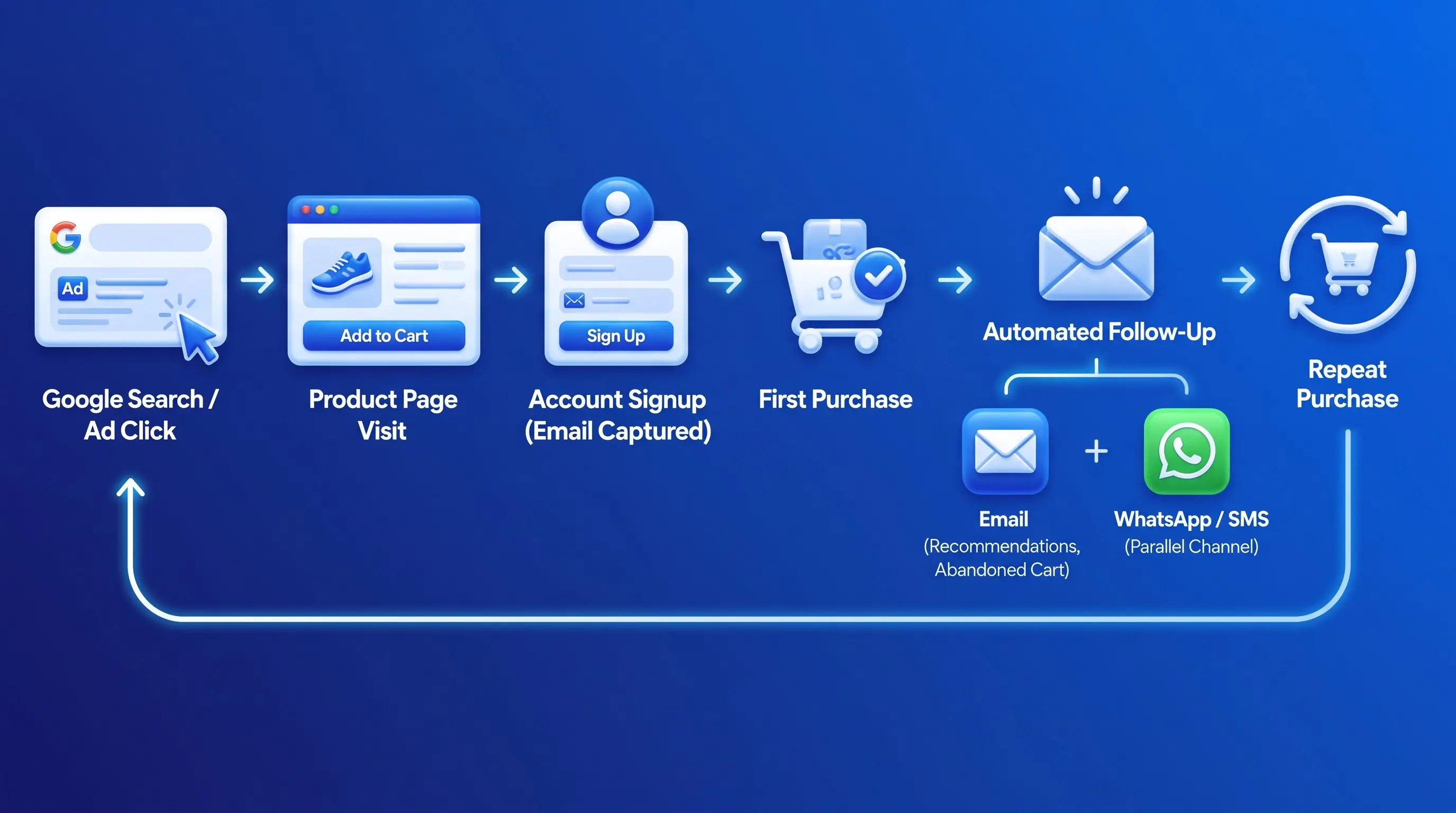
A simple six-stage horizontal flow: Google Search / Ad Click → Product Page Visit → Account Signup (Email Captured) → First Purchase → Automated Follow-Up (Email, Recommendations, Abandoned Cart, WhatsApp/SMS) → Repeat Purchase
Is Email Marketing Cheaper Than Paid Ads?
This is where most companies get stuck: Google Ads charges you for the opportunity to win a customer's attention, while email marketing charges you to manage and communicate with an audience you already own.
In Google Ads, businesses typically compete in a live auction and pay when a user clicks their ad. As a broad benchmark, search advertising can range from under $1–$2 per click in less competitive categories to $10–$50+ in highly competitive industries such as legal, finance, and insurance. Actual CPC varies significantly by keyword, industry, location, quality score, and competition. Because you pay per click, scaling your traffic requires scaling your budget proportionally.
Email works differently. You are not entering a new advertising auction every time a subscriber receives your message. Instead, your costs are driven primarily by contact/emails tier pricing, where you pay a flat monthly software fee based on the size of your subscriber database. For example, a platform might charge $14/month to manage a base of 1,000 contacts, which scales to roughly $50/month as your audience grows to 10,000 contacts on Boldinbox. This model means your average cost per contact drops by more than half as you scale, allowing you to message the same opted-in audience repeatedly without facing incremental media costs or ad auctions for every single send.
However, this doesn't automatically make email "free" or inherently "cheaper"-it means the cost models serve different stages of the business lifecycle.
Comprehensive Channel Comparison
|
Factor |
Email Marketing |
Paid Advertising (Google Ads) |
|
Cost Model |
Subscription-Based: Fixed monthly platform/software fees scaled by contact database tiers. |
Performance-Based: Dynamic pay-per-click (CPC) or pay-per-impression (CPM) costs. |
|
Example Pricing |
$14 to $50+ per month to host and market to a base of 1,000 to 10,000 contacts only on Boldinbox Emailer Software. |
CPC ranges from <$1–$2 to $10–$50+ depending entirely on keyword auction competition. |
|
Primary Role |
Retention and Monetization: Nurturing leads, maximizing repeat purchases, and building customer loyalty. |
Acquisition and Demand Capture: Generating immediate traffic, launching products, and reaching new audiences. |
|
Audience |
Owned Audience: Existing, warm, opted-in subscribers who have already interacted with your brand. |
Rented Audience: Cold or intent-driven users actively searching or browsing external platforms. |
|
Ownership |
High Autonomy: You own the data list; you don't depend on external network algorithms for access. |
Platform Dependent: Access to the audience ends the moment your media budget stops or ad auctions shift. |
|
Speed to Results |
Delayed / Compound: Requires an upfront investment in list-building and ongoing relationship nurturing. |
Immediate: Can generate high-intent traffic to a landing page within hours of launching a campaign. |
|
Scalability Limit |
Scales efficiently with list size and engagement quality without multiplying media spend. |
Scales fluidly with available budget and search demand volume. |
|
Best Used For |
Newsletters, lifecycle automations, cart abandonment recovery, and customer loyalty rewards. |
Target keyword capturing, localized service leads, and immediate product launches. |
The Strategic Distinction
The core difference is simple: with paid ads, every additional click creates a brand-new advertising cost. With email, you pay a flat fee to maintain the relationship, allowing you to reach that same subscriber multiple times without paying for them twice.
However, both channels carry hidden operational costs. Paid advertising requires constant budget optimisation, asset creation, and landing page development to maintain high quality scores. Email requires investing in technical deliverability setups, list hygiene (cleaning out unengaged profiles), design templates, and automated sequence workflows.
Industry benchmarks highlight this efficiency. Research from Litmus indicates that email marketing generates an average ROI of $36 for every $1 spent. While this benchmark should be treated as an aggregate average rather than a guarantee, it reflects the compound value of managing an owned list over time.
Ultimately, one question comes up: "Which channel costs less?"
Where does my customer acquisition spending go, and which channel am I relying on to strengthen and monetize that relationship?
Amazon And Flipkart Capture Demand Two Different Ways
Large marketplaces are useful because they visibly run both models at once, at scale, which makes the acquisition-versus-retention distinction concrete instead of abstract.
Google Ads capture active intent. When someone searches for "waterproof hiking boots," that search itself is a signal of intent right now, and advertisers bid to be the answer. It's demand capture in its purest form - no prior relationship required, which is exactly why it's the right tool for reaching people who've never heard of you.
Login-based identity captures returning demand. Creating an account, through email, phone, or a linked login, lets a platform recognise the same person across visits instead of treating every session as new. Once that identity exists, order updates, restock alerts, and recommendations can go to a specific returning customer instead of a one-time visitor who's now unreachable.
Recommendations connect the two. “Customers who viewed this also purchased,” or a tailored homepage feed, connects a shopper’s past behaviour with the wider product catalogue. This is publicly observable behaviour in how these platforms function - not a claim about their internal ranking algorithms, which aren't public and shouldn't be guessed at.
Why Ecommerce Sites Ask For Your Email
Email has become one of the most common identity anchors online, not because of one universal law, but because it's a convenient way to verify a person and maintain contact after the first visit ends.
The practical reasons an ecommerce site collects an email address: account creation and verification, order and shipping updates, receipts, password recovery, product recommendations, customer support correspondence, and - separately, with its own consent requirements - marketing communication. Transactional email (an order confirmation, a shipping notice) is generally expected as part of using the service. Marketing email (a promotional campaign, a newsletter) is a distinct category that requires the recipient's consent, and increasingly, specific documentation of how that consent was obtained.
This distinction matters more in India now than it did even two years ago. The Digital Personal Data Protection Act, 2023, alongside Rules notified in November 2025, requires businesses to obtain clear, informed, specific, unconditional, and freely given consent before sending marketing emails. Pre-ticked boxes and bundled consent don't qualify. Withdrawal has to be as easy as giving consent in the first place, and penalties for non-compliance can run up to ₹250 crore per breach. The rules use a phased commencement timeline, with several substantive provisions taking effect 18 months after publication, so businesses collecting emails for marketing in India should be building consent practices toward this standard now rather than waiting for enforcement.
Government services, banks, and workplace systems use email for broadly similar reasons - verification, notifications, account recovery - though specific requirements vary by service, institution, and jurisdiction. It's inaccurate to describe any single universal mandate here; the pattern is consistent, the specific rules aren't.
The Real Economics: Acquisition Cost vs. Retention Cost
Every new customer costs something to acquire, whether through ad spend, SEO investment, or a discount used to win a first purchase. Customer acquisition cost (CAC) captures this directly: total acquisition spend divided by customers actually acquired. This cost is incurred once per new customer, regardless of which channel closed the sale.
Retention economics work differently. Once someone is a subscriber who's consented to marketing email, reaching them again doesn't require a new per-message media auction the way paid traffic does. That's the core distinction: advertising requires ongoing spend to generate paid traffic, while email can repeatedly reach an existing audience at a lower marginal cost per additional message - not zero cost, since platform fees, creative production, list management, deliverability management, and compliance overhead are all real, ongoing expenses.
Google's HubSpot-reported 2025 benchmarks put average email open rates around 42% and click-through rates around 2.5% - figures that vary substantially by industry and list health, but useful as a general reference point when evaluating whether a specific campaign is performing normally.
What A Realistic Email Campaign Actually Looks Like
A common claim in email marketing content is that a campaign only needs a handful of incremental sales to be worth running. That's directionally true, but the examples used to illustrate it are often unrealistic - a conversion rate low enough to sound made up doesn't actually help anyone plan a real campaign. Here's a version built on a plausible conversion rate, with the formula shown so you can substitute your own numbers.
The formula:
Orders = Segment size × conversion rate Contribution = Orders × average order value × gross margin % Campaign result = Contribution − campaign cost
A hypothetical example:
-
Segment: 5,000 opted-in, moderately engaged customers (not the full list - a relevant segment)
-
Conversion rate: 0.6% (a conservative, realistic rate for a promotional send to a warm segment)
-
Orders generated: 30
-
Average order value: ₹2,500
-
Gross margin: 40%
-
Contribution per order: ₹1,000
-
Total contribution: ₹30,000
-
Campaign cost: ₹10,000
-
Net result: ₹20,000 positive, before accounting for broader platform and overhead costs
This is a hypothetical illustration, not a benchmark to expect. Real conversion rates vary widely by industry, offer strength, list engagement, and how "conversion" is attributed. A poorly segmented campaign to a disengaged list can lose money just as easily as a well-targeted one can turn a solid profit from a modest number of sales - the mechanism is sound, but the inputs are what determine the outcome.
Beyond Email: WhatsApp, SMS, and India's Broader Retention Stack
Email doesn't operate in isolation in the Indian ecommerce market, and any strategy discussion that ignores WhatsApp specifically is missing a major piece of the retention picture. WhatsApp had roughly 535 million monthly active users in India as of 2025 - DataReportal's figure, cited widely across industry sources - and is installed on close to 94% of Indian Android smartphones. Commonly cited open rates for WhatsApp business messages run in the 90%+ range, well above typical email open rates in the high teens to low twenties, though these figures vary by source and measurement methodology and shouldn't be treated as a precise, universal number.
What this means practically: WhatsApp and SMS have become primary channels for time-sensitive, high-urgency communication in India - order confirmations, delivery updates, abandoned cart nudges sent within a narrow window - while email remains stronger for richer content: newsletters, detailed product recommendations, and longer-form lifecycle campaigns where a full inbox layout adds value that a chat message can't. Treating WhatsApp, SMS, and email as competing channels for the same message misses the point; the stronger pattern in practice is using each for what it does best, often within the same customer journey (a WhatsApp nudge for an abandoned cart, followed by an email with broader recommendations days later).
A Live Example: Prepping Email And Ads Around Flipkart And Amazon's Festive Sales
The clearest way to see acquisition and retention channels running in parallel isn't a hypothetical - it's happening on the two biggest ecommerce calendars in India right now. Flipkart has confirmed Big Billion Days 2026 starts October 9, with early access from October 8 for Plus, Black, and Flipkart credit card members, and a 10% instant discount on Axis Bank and ICICI Bank cards. Amazon has confirmed the Great Indian Festival 2026 starts October 8, with 24-hour Prime early access from October 7, a 10% instant discount on SBI cards, and up to an extra 10% for Prime members. Both events land in the same week, as they have for several years running, and both lean on the same core categories: smartphones, laptops, smart TVs, large appliances, and fashion.
This is a genuinely useful window for seeing the two-channel pattern in practice. A brand selling into either marketplace typically runs two tracks starting roughly a month before the sale opens - which, for this year's October 8–9 start, means the work begins in early-to-mid September:
The ads track starts with sponsored placements on the marketplace itself, aimed at people actively browsing categories that go on sale. This is demand capture in the purest sense described earlier in this article: someone searching "smart TV deals" or browsing smartphones in the run-up to BBD or GIF is showing intent right now, and sponsored placement is how a seller gets in front of that specific search.
The email track runs in parallel, aimed at the brand's own existing subscriber list rather than the marketplace's traffic. This typically means a short warm-up sequence: an early notice that the sale is coming, a reminder close to the early-access window for Plus, Black, or Prime members specifically, and a final push once the sale is publicly live. None of this requires paying for placement - it's the owned-audience advantage in action, at exactly the moment ad costs on the marketplace itself are climbing due to increased seller competition for the same sale-driven search traffic.
It's worth separating this from Amazon's Prime Big Deal Days, a separate fall sale event running October 6–7, 2026, primarily in the US market - distinct from the India-focused Great Indian Festival, even though the names and timing are close enough to confuse planning calendars that mix both markets.
Key Festive Dates And Offers For The Rest Of 2026
The festive calendar doesn't stop at BBD and GIF, and each event that follows is its own reason to run a fresh ads-plus-email push rather than one long, undifferentiated campaign stretching from September to January.
|
Festival / Event |
2026 Date |
Typical Ecommerce Offers |
|
Navratri |
October 11–19 (Sharad Navratri) |
Runs alongside the tail end of BBD/GIF; ethnic wear, festive fashion, and home-décor discounts, plus continued bank card offers as platforms keep momentum going into Dussehra. |
|
Dussehra |
October 20 |
A dedicated "Dussehra sale" typically follows BBD, with continued discounts on electronics and appliances, bank card instant discounts (commonly Axis, ICICI, or SBI), and Pay Later/EMI options aimed at shoppers who missed the BBD window. |
|
Diwali (Big Bang Diwali Sale) |
November 8 (Dhanteras November 6, Bhai Dooj November 11) |
The final wave of the festive season - historically a shorter, sharper sale in the days around Diwali, with instant bank discounts, cashback on wallet/UPI payments, and steep markdowns on electronics, jewelry-adjacent categories, and gifting items to capture last-minute Dhanteras and Diwali gifting demand. |
|
Christmas |
December 20–25 |
Amazon's Christmas sale window, generally focused on electronics, gadgets, and gifting categories, plus year-end clearance pricing on select inventory. |
|
New Year's |
December 26 – January 1 |
Overlaps with Flipkart's Year-End Sale (expected to begin around December 5) and runs through New Year's Day; typically clearance pricing on outgoing-season stock, appliance and electronics discounts, and "new year, new deals" gifting promotions. |
Flipkart has additional events expected through the quarter beyond BBD: a Dussehra sale in mid-October, a Big Bang Diwali Sale around the November 8 Diwali date, and a Year-End Sale expected to begin around December 5 that runs into the New Year. Amazon's calendar includes a Black Friday sale in late November and the Christmas sale window from December 20–25. Each of these represents a separate, smaller version of the same pattern - a fresh reason to run both a marketplace ad push and a dedicated email sequence to the existing list, rather than treating the festive season as one single event to prepare for.
Building A Strategy That Uses Both
Combine acquisition and retention channels deliberately. Paid and organic search are generally stronger at reaching people who don't yet know your brand. Email, WhatsApp, and SMS are generally stronger at reaching people who already do. Using search and ads to build the audience, then email and messaging to develop that relationship over time, reflects how the economics of each channel actually work - not a preference for one over the other.
Track revenue, not just engagement metrics. Open rate and click-through rate are diagnostic, not conclusive. Revenue per recipient and email-attributed revenue against campaign cost are what actually determine whether a program is working.
Treat abandoned cart recovery as a priority automation, not an afterthought. A shopper who added something to their cart and left has already shown strong intent - stronger than someone who merely opened a newsletter. An automated recovery sequence, timed within hours rather than days, allows the brand to recover that purchase intent while it is still fresh.
Build first-party data deliberately. As third-party tracking continues to erode, data collected directly - through account creation, purchase history, and email or WhatsApp engagement - becomes proportionally more valuable and useful well beyond email alone, including for improving on-site personalization and building better-targeted paid audiences.
Since February 2024, Google and Yahoo have introduced stricter requirements for bulk senders, while Microsoft has introduced comparable requirements for high-volume senders to Outlook and Hotmail. Meeting these requirements does not guarantee inbox placement, but non-compliance can lead to spam placement or rejection.
Where Boldinbox Fits
Boldinbox is an email marketing platform, and it's relevant to disclose that directly here rather than let the mention pass without context: this is our own product, referenced because it's genuinely applicable to the deliverability and segmentation points above, not because it's positioned as the universal answer to the acquisition-versus-retention question this article covers.
A concrete use case: an ecommerce brand running an abandoned cart flow needs two things working together - a trigger fast enough to catch real purchase intent, and authentication solid enough that the recovery email actually reaches the inbox instead of getting caught by a spam filter or rejected outright under the 2024 bulk sender rules. Boldinbox builds SPF/DKIM/DMARC guidance and deliverability monitoring into onboarding rather than leaving it for a business to discover after a campaign underperforms, which is the specific gap it's built to close. It's one option among several established platforms, and the right choice for any given business still depends on list size, existing tooling, and budget - the underlying DNS and authentication mechanics work the same regardless of which platform generates the setup instructions.
Conclusion
The real opportunity is not choosing between email marketing and paid ads, but understanding where each channel fits in the customer journey. Paid ads can bring new shoppers to an ecommerce store, while email helps turn those visitors and customers into repeat buyers through timely, relevant communication. During major festive periods, this combination becomes even more useful as brands compete for attention and sales. The key is to look beyond campaign costs and measure the full picture, including acquisition, conversions, repeat purchases, and customer value. When both channels work together, ecommerce marketing becomes more connected and sustainable.
FAQs
1. Does email marketing beat paid ads?
Not as a general rule - the answer depends on acquisition stage, existing audience size, purchase frequency, margins, and advertising costs in your specific market. A subscription business with high repeat purchase rates will likely see stronger ROI from email on retention activity. A new brand with no existing audience has to lean on advertising or search first, because email can't reach people who aren't on the list yet.
2. Why do ecommerce sites request email addresses?
For account verification, order and shipping communication, password recovery, personalization, and - separately, requiring specific consent - marketing communication. Transactional and marketing emails are governed by different expectations and, in India, different consent standards under the DPDP Act.
3. Can email reduce advertising dependence?
For existing customers and opted-in subscribers, yes, particularly where repeat purchases are common. It doesn't replace the need for new customer acquisition, SEO, paid media, or brand building - the channels that bring new people into the relationship in the first place.
4. How do Amazon and Flipkart use email?
Based on publicly observable practices: account communication, order and shipping notifications, product recommendations, and promotional or lifecycle communication tied to account activity. Neither company's internal targeting systems or proprietary algorithms are public information, and this article makes no claim to that knowledge.
5. Is WhatsApp replacing email for Indian ecommerce brands?
Not replacing - supplementing. WhatsApp's reach and open rates in India are genuinely higher for urgent, time-sensitive messages, but email remains better suited to richer content and longer-form lifecycle campaigns. Most mature Indian ecommerce programs use both, matched to message type rather than picking one channel exclusively.
6. What does the DPDP Act require for email marketing consent?
Consent must be free, specific, informed, unconditional, and given through clear affirmative action - pre-ticked boxes and bundled consent don't qualify. Opting out should be as simple as joining. Penalties for non-compliance can reach ₹250 crore per breach, with a phased commencement timeline under the DPDP Rules.
7. When are the major Indian festive sales in 2026, and what offers should I expect?
Navratri runs October 11–19 alongside the tail end of BBD/GIF with festive fashion and décor discounts; Dussehra follows on October 20 with continued electronics deals and bank card offers; Diwali falls on November 8 (Dhanteras November 6, Bhai Dooj November 11) and typically brings the year's sharpest last-minute discounts and cashback; Christmas runs December 20–25 with gifting and electronics deals; and New Year's (December 26–January 1) overlaps with year-end clearance sales running into January.
Key Takeaways
-
Ads capture demand from people who don't know a brand yet. Email monetizes relationships with people who already do - they solve different problems, not competing versions of the same one.
-
Email isn't free marketing. It has real, ongoing costs; its advantage is a lower marginal cost per additional message to an existing audience, not zero cost.
-
Since February 2024, Google and Yahoo (and Microsoft from May 2025) require authentication, low complaint rates, and one-click unsubscribe from bulk senders - non-compliance now risks outright rejection.
-
WhatsApp's reach and open rates in India are substantial and belong in the same conversation as email, particularly for time-sensitive communication like abandoned cart recovery.
-
India's DPDP Act meaningfully raises the bar for how marketing consent has to be collected and documented, with real financial penalties attached.
-
Festive sale dates matter for planning: Navratri (Oct 11–19), Dussehra (Oct 20), Diwali (Nov 8), Christmas (Dec 20–25), and New Year's (Dec 26–Jan 1) each deserve their own ads-plus-email push rather than being folded into one long campaign.
-
The strongest ecommerce strategies use acquisition channels (ads, search) to build the audience and retention channels (email, WhatsApp, SMS) to make that audience valuable over time - not one instead of the other.
Want help auditing your own campaign economics or deliverability setup? [Talk to the Boldinbox team] - no pressure, just a second set of eyes on the numbers.
Tags: Email Marketing Vs Paid Ads, Email Marketing Vs Google Ads, Amazon Great Indian Festival 2026, Amazon Great Indian Festival Dates 2026, Amazon Festive Sale 2026 Offers, Flipkart Big Billion Days 2026, Flipkart Big Billion Days Dates 2026, Christmas 2026 Ecommerce Sale, New Year 2026 Ecommerce Sale, Amazon Diwali Offers 2026.
Table Of Contents
- Suggested Ads-to-Email Journey Diagram
- Is Email Marketing Cheaper Than Paid Ads?
- Comprehensive Channel Comparison
- Amazon And Flipkart Capture Demand Two Different Ways
- Why Ecommerce Sites Ask For Your Email
- The Real Economics: Acquisition Cost vs. Retention Cost
- What A Realistic Email Campaign Actually Looks Like
- Beyond Email: WhatsApp, SMS, and India's Broader Retention Stack
- A Live Example: Prepping Email And Ads Around Flipkart And Amazon's Festive Sales
- Building A Strategy That Uses Both
- Where Boldinbox Fits
- Conclusion
- FAQs
- Key Takeaways