
How to Build a Full-Funnel Email Marketing Strategy for Maximum Revenue
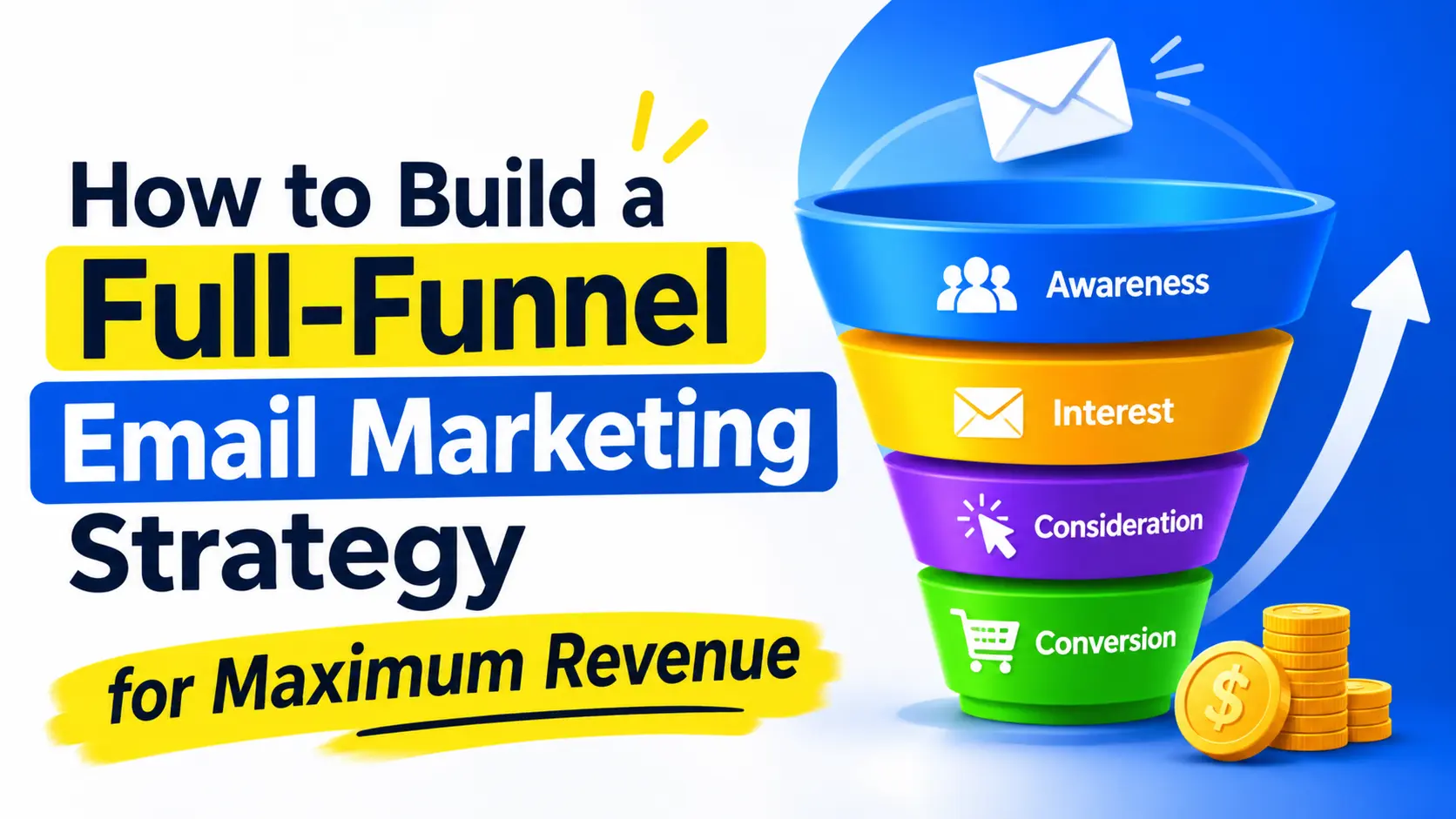
Table Of Contents
- How the Email Marketing Funnel Works
- The Five Stages: Awareness, Consideration, Conversion, Retention, Loyalty
- What Email Does at Each Stage
- How Subscribers Move Between Stages
- Build an Email List That Converts
- Permission-Based List Building Principles
- Lead Magnets That Attract the Right Subscribers
- Website Forms, Landing Pages, and Newsletter Sign-Ups
- Other Legitimate Acquisition Channels
- Practical Recommendations for List Quality
- Segment Subscribers by Intent and Behaviour
- Demographic and Firmographic Segmentation
- Behavioural and Engagement-Based Segmentation
- Lifecycle and Purchase-Intent Segmentation
- Practical Segmentation Examples
- Avoiding Segmentation Mistakes
- Create Automated Emails for Every Stage
- Awareness: Welcome Sequences and Educational Campaigns
- Consideration: Lead Nurturing and Product Recommendations
- Conversion: Abandoned Cart and Trial Conversion Emails
- Retention: Post-Purchase and Re-Engagement Emails
- Loyalty: Rewards, Referrals, and Advocacy Emails
- Workflow Governance and Frequency Control
- Improve Email Conversions and Revenue
- What to Look for in an Email Marketing Platform
- A Full-Funnel Example: One Subscriber Through All Five Stages
- Measure Email Marketing ROI and Performance
- Conclusion
- References
A full-funnel email marketing strategy uses email to guide subscribers through every stage of the customer journey: awareness, consideration, conversion, retention, and loyalty. Instead of sending one-off promotions to a single list, the business designs connected messages that match what each subscriber needs at each moment, and measures revenue across the whole relationship rather than per campaign.
This guide explains how to build that system. It covers how the funnel works, how to grow a list of relevant subscribers, how to segment by intent and behaviour, which automations belong at each stage, how to improve conversions without over-mailing, and how to measure return on investment honestly. Examples are hypothetical illustrations of how the concepts apply, not verified case studies.
How the Email Marketing Funnel Works
The email marketing funnel is the sequence of communications that moves a person from first discovering a brand to buying repeatedly and recommending it to others. Each message has one job tied to the subscriber's current stage. A welcome email builds familiarity, a comparison guide supports a decision, and a replenishment reminder encourages a repeat purchase. The strategy works because the message, offer, and call to action change as the relationship matures. The email funnel generally begins at the point a visitor becomes a subscriber. Brand discovery often happens earlier, through search, social media, advertising, or word of mouth, and that earlier activity falls outside email's reach. In this framework, "awareness" describes how a new subscriber gets to know the brand through email, not how they first found it.
This matters because email is an owned channel. Unlike social platforms or search results, the brand controls the list, the timing, and the data collected. That ownership makes email well suited to long-term relationship building, but only when permission, relevance, and sender reputation are protected. A list that is mailed indiscriminately loses engagement, and weak engagement damages inbox placement for every future campaign.
The Five Stages: Awareness, Consideration, Conversion, Retention, Loyalty
This article uses one consistent framework: Awareness → Consideration → Conversion → Retention → Loyalty. Subscribers do not always move in a straight line, and some skip stages, but the framework gives every email a clear purpose.
| Stage | Subscriber state | Email goal | Typical email types |
| Awareness | Recently discovered the brand, low commitment | Build trust and familiarity | Welcome series, newsletters, educational content |
| Consideration | Evaluating options and solutions | Reduce uncertainty, demonstrate value | Comparison guides, case-style stories, product education |
| Conversion | Ready or nearly ready to act | Remove friction and prompt action | Cart reminders, trial-to-paid prompts, time-bound offers |
| Retention | Has bought or activated | Ensure success and encourage repeat use | Onboarding, post-purchase care, replenishment, cross-sell |
| Loyalty | Repeat customer with a strong relationship | Deepen value and generate advocacy | Loyalty rewards, early access, referral invitations |
The table also clarifies a common mistake. Many businesses invest heavily in conversion emails and neglect retention and loyalty, even though existing customers are usually the most responsive audience and the cheapest to reach.
What Email Does at Each Stage
At the awareness stage, email introduces the brand's expertise and sets expectations for what the subscriber will receive. The tone is helpful rather than promotional. A software company might send a short series covering the problem its product solves, without pushing a demo in the first message.
At the consideration stage, email answers objections and supports comparison. A travel company might send destination guides, itinerary ideas, and a clear explanation of what is included in a package. A B2B firm might share implementation checklists that help a buyer justify the decision internally.
At the conversion stage, messages become more direct. They reduce friction by clarifying price, delivery, guarantees, or next steps. At retention, email helps the customer succeed with what they bought, which lowers returns, refunds, and churn. At loyalty, email recognises the relationship through rewards, early access, and referral invitations.
How Subscribers Move Between Stages
Movement between stages is triggered by behaviour, not by the calendar. A subscriber who clicks several pricing-related links is likely further along than one who only opens newsletters. A customer who has not purchased in a typical reorder window may need a retention message even though they are technically a customer.
This is why the funnel depends on data. Subscriber actions such as clicks, page visits, purchases, and support interactions should determine which sequence a person enters or exits. The later sections on segmentation and automation explain how to build those rules.
Build an Email List That Converts
A list that converts is made of people who chose to subscribe, want what the brand offers, and fit the audience it can serve. List size alone is a weak indicator of success. A smaller list of relevant, engaged subscribers usually produces more revenue, lower complaint rates, and better deliverability than a large list built through broad incentives or purchased contacts.
Permission-Based List Building Principles
Permission-based email means the subscriber has knowingly agreed to receive messages from the sender. Buying, renting, or scraping email addresses violates this principle, increases spam complaints, and can breach privacy laws such as GDPR in the European Union and CAN-SPAM in the United States. Legal requirements vary by region, so businesses should confirm their obligations with qualified counsel.
Good practice includes clear sign-up language that states what will be sent and how often, a visible unsubscribe option in every message, and honest sender identification. Many senders use double opt-in, which asks new subscribers to confirm their address. It reduces typos, spam traps, and fake sign-ups, though it also adds a step that some genuine subscribers never complete. Whether to use it depends on the audience, region, and risk tolerance.
Lead Magnets That Attract the Right Subscribers
A lead magnet gives visitors something useful in return for their email. Better resources attract more relevant subscribers. A generic discount attracts bargain hunters, while a specific resource attracts people with a specific problem. An accounting platform offering a small-business tax calendar will attract owners who may later need accounting software, whereas a generic sweepstakes attracts people who may never buy.
Effective lead magnets share several traits:
-
They solve a narrow, real problem quickly, such as a checklist, template, calculator, or buying guide.
-
They connect naturally to the product or service, so the follow-up emails feel relevant.
-
They reveal intent, since the topic chosen tells the brand which stage and interest the subscriber belongs to.
-
They deliver value immediately, with the first email arriving within minutes.
Website Forms, Landing Pages, and Newsletter Sign-Ups
Sign-up placement affects both volume and quality. Embedded forms in blog posts and footers capture readers who are already engaged, while dedicated landing pages work well for specific offers promoted through search, social media, or advertising. Pop-ups and exit-intent forms can perform well but should be limited in frequency and easy to dismiss, because aggressive interruptions can harm user experience.
Forms should ask only for what the first email requires. An email address alone reduces friction, and one additional field, such as a topic preference or role, can enable useful segmentation from day one. Every extra field should earn its place. Progressive profiling, where more information is collected gradually through later interactions, usually works better than a long initial form.
Other Legitimate Acquisition Channels
Several other channels grow a list without compromising permission:
-
Checkout and account creation: collect marketing consent with a clear, unticked opt-in rather than assuming it.
-
Webinars and events: registration reveals a strong topical interest, provided consent for ongoing email is requested separately.
-
Content upgrades: a downloadable companion to an article offers more value than a generic newsletter prompt.
-
Referral programmes: existing customers invite contacts who often arrive with higher trust.
-
In-store and offline capture: tablets, QR codes, or receipts with sign-up links, again with explicit consent.
Practical Recommendations for List Quality
Start by defining the ideal subscriber. Describe the problem they face, the stage they are likely in, and what would make them eventually buy. Then design the offer and the sign-up experience for that person only.
Next, protect list health from the beginning. Secure domain authentication through SPF, DKIM, and DMARC. SPF lists which servers may send mail for the domain, DKIM adds a cryptographic signature that verifies the message was not altered, and DMARC tells receiving servers how to handle messages that fail those checks. Google and Yahoo introduced requirements for bulk senders in 2024, including authentication, easy one-click unsubscribe, and low spam complaint rates, so these steps are now operational necessities rather than optional improvements.
Make time to phase out subscribers who remain inactive. A sunset policy that suppresses contacts who have not engaged after repeated re-engagement attempts protects sender reputation and gives a more accurate picture of audience performance.
Segment Subscribers by Intent and Behaviour
Segmentation divides a list into groups that receive different messages based on shared characteristics. It is the mechanism that makes a funnel possible, because the same email cannot serve a first-time subscriber and a ten-time buyer. The goal is relevance: each subscriber receives communication that reflects who they are and what they have done.
Demographic and Firmographic Segmentation
Demographic segmentation uses attributes such as location, language, age range, or job role. In B2B, the equivalent is firmographic data such as company size, industry, and the subscriber's seniority. These attributes are useful for obvious adjustments, including currency, time zone, regional offers, and role-specific language.
Demographics alone are a blunt tool. Two subscribers of the same age and location can have entirely different intentions. Use demographic data as a baseline layer, then add behavioural signals on top of it.
Behavioural and Engagement-Based Segmentation
Behavioural segmentation uses actions such as pages viewed, links clicked, products browsed, content downloaded, and features used. Engagement-based segmentation looks at how subscribers respond to email itself, including recent opens, clicks, and replies.
A note on measurement: Apple Mail Privacy Protection, introduced in 2021, pre-loads email content for many users and inflates open rates. Opens are therefore an unreliable sole signal. Clicks, site activity, and purchases are stronger indicators of real engagement. A practical engagement model might define active subscribers as those who clicked or purchased in the last 60 to 90 days, at risk as those with declining activity, and inactive as those with no meaningful activity beyond a longer window suited to the business's buying cycle.
Lifecycle and Purchase-Intent Segmentation
Lifecycle segmentation aligns directly with the funnel. Typical segments include new subscribers, engaged prospects, first-time buyers, repeat customers, lapsed customers, and loyal advocates. Each maps to one of the five stages and receives a different programme of emails.
Purchase-intent segmentation identifies how close someone is to buying. Signals include repeated visits to a pricing page, adding items to a cart, comparing products, requesting a quote, or starting a free trial. High-intent signals justify more direct messages, while low-intent signals suggest continued education.
Practical Segmentation Examples
The following hypothetical examples show how rules translate into action:
-
E-commerce retailer: a subscriber who viewed running shoes twice but did not buy enters a consideration sequence featuring sizing guidance, reviews, and care information. A first-time buyer enters a post-purchase sequence, while a customer with three or more orders is invited to a loyalty programme.
-
SaaS company: a trial user who has not completed a key setup action receives onboarding help, while one who has invited teammates receives upgrade information relevant to team plans.
-
Travel company: a subscriber who browsed family holidays receives family itineraries, while one who searched city breaks receives short-trip ideas.
-
Educational institution: a prospective student who attended an open day receives application deadline reminders, while one who only downloaded a prospectus receives programme comparisons.
Avoiding Segmentation Mistakes
Over-segmentation is a common problem. Dozens of micro-segments create content workload that the team cannot sustain, and the data behind small groups can be too thin to act on. Begin with a handful of segments tied to the funnel stages, prove the value, and expand where the data supports it.
Another mistake is relying on stale data. A subscriber's interests and stage change, so segments should update dynamically through automation rather than being rebuilt manually. Finally, respect privacy: use data that subscribers reasonably expect to be used, and be transparent about it.
Create Automated Emails for Every Stage
Email automation sends messages triggered by subscriber actions or conditions, rather than by a manual campaign schedule. Automation makes the funnel scalable, because each subscriber receives a timely message when the trigger occurs. Automated emails tend to be highly relevant because they respond to specific behaviour, which is why they often account for a disproportionate share of email revenue in mature programmes.
Every workflow needs a clear entry condition, an exit condition, a goal, and a limit on message frequency. Without exit rules, a customer who already purchased may continue to receive messages about the cart they just completed.
Awareness: Welcome Sequences and Educational Campaigns
A welcome series is one of the highest-attention sequences a brand will send, because new subscribers have just expressed interest. A strong series introduces the brand, delivers the promised lead magnet, explains what future emails will contain, and invites a low-effort action, such as choosing topic preferences.
Educational campaigns extend this by sharing useful content over several days or weeks. A B2B software provider might send a five-part series on a common operational problem. The aim is to build credibility and learn about interests through clicks, not to force an early sale.
Consideration: Lead Nurturing and Product Recommendations
A lead nurturing sequence guides prospects who have shown interest but are not ready to decide. It addresses typical objections, explains how the product works, and shares proof such as customer stories, reviews, or implementation guides. Only use genuine testimonials and verifiable results.
Product recommendation emails use browsing history, category interest, or past purchases to suggest relevant items. Recommendations work best when they explain why an item is suggested and avoid showing products the subscriber has already bought. A retailer might recommend complementary items after a first purchase, which also supports the retention stage.
Conversion: Abandoned Cart and Trial Conversion Emails
Abandoned cart emails target shoppers who added items but did not complete checkout. A common structure is a first reminder within a few hours, a second message the next day addressing common concerns such as shipping, returns, or sizing, and an optional third message later. Whether to include a discount depends on margin and brand positioning, since routine discounting can train customers to abandon carts deliberately. Testing is the right way to decide.
SaaS companies use this approach to turn trial users into customers. It highlights features the user has not yet tried, reminds them of the trial's end date, and makes upgrading simple. Service businesses can use a similar pattern after a quote request.
Retention: Post-Purchase and Re-Engagement Emails
Post-purchase emails confirm the order, set delivery expectations, provide usage or care guidance, and later request a review. A well-designed sequence lowers support requests and returns while producing review content that supports future acquisition.
Re-engagement campaigns target subscribers or customers whose activity has declined. They might acknowledge the gap, offer a preference update, share recent highlights, or provide a relevant incentive. If the subscriber still does not respond, the sunset policy removes them from regular mailing. This protects deliverability and keeps reporting honest.
Customer retention sequences go further for existing customers. A subscription brand might send replenishment reminders before supplies run low, while a software company might share advanced feature tutorials at the point when usage typically plateaus.
Loyalty: Rewards, Referrals, and Advocacy Emails
Loyalty emails recognise repeat customers through points updates, early access to new products, milestone messages, and exclusive content. These emails work because they reinforce the relationship instead of repeatedly pushing a transaction.
Referral emails invite satisfied customers to recommend the brand, ideally with a benefit for both parties. They are most effective after a positive moment, such as a successful delivery, a high review score, or a completed milestone. Timing the request after a negative experience would undermine trust.
Workflow Governance and Frequency Control
Multiple automations can overlap. A customer might simultaneously qualify for a re-engagement message, a cross-sell, and a loyalty update. Set priority rules so that only the most relevant message sends, and cap the total number of emails per subscriber per week. Review each workflow periodically, because links, offers, and product information go out of date, and an unattended automation can quietly damage results for months.
Improve Email Conversions and Revenue
Improving email revenue is mostly a matter of increasing relevance and reducing friction, not increasing volume. Sending more messages can raise short-term clicks while raising unsubscribes and complaints, which reduce long-term revenue. The following practices improve results while respecting the subscriber.
Personalisation Beyond the First Name
Personalisation means adapting content to the individual using data they have shared or generated. Addressing someone by their first name feels rather basic. More valuable forms include recommending products related to past purchases, adjusting content by lifecycle stage, referencing the specific resource a subscriber downloaded, and changing the offer based on purchase history.
Personalization has limits. Messages that reveal too much awareness of private behaviour can feel intrusive, and personalization based on poor data creates errors that damage trust. Use only data subscribers would reasonably expect the brand to hold.
Subject Lines, Preview Text, and Email Copywriting
Your subject line and preview text shape the decision to open an email. Strong ones are specific, honest, and relevant to the recipient. Misleading subject lines may raise opens in the short term but increase complaints and breach advertising rules in many jurisdictions.
In the body, write for scanning. Lead with the most important point, keep paragraphs short, and focus on one main message per email. Describe benefits in terms of the reader's problem rather than listing features. Plain, conversational copy often outperforms heavily designed templates for relationship-style emails, though the correct balance depends on the audience and should be tested.
Calls to Action and Landing Page Alignment
Each email needs one primary action, expressed in clear language such as “See sizing guide” or “Book a demo”. Competing links dilute attention. The call to action should also match the funnel stage: asking a new subscriber to buy immediately is usually less effective than asking them to read a helpful guide.
The page must match the promise made in the email. If the email highlights a specific product or offer, the page should show exactly that, with the same wording, price, and visual cues. Mismatch is a common cause of lost conversions, particularly on mobile, where most email is read. Test pages on small screens before launching a campaign.
Send-Time Optimization and Frequency
There is no universally best day or hour to send. The right timing depends on the audience, the type of email, and when subscribers are likely to read. B2B audiences may engage during working hours, while consumer audiences may respond in the evening or at weekends. Many email platforms offer send-time optimization based on individual behaviour, and these tools can help, but they should be validated against real results.
For frequency, let engagement guide the decision. Subscribers who interact often can tolerate more messages than those who rarely click. Offering a preference centre, where people choose topics and frequency, is a practical way to retain subscribers who might otherwise unsubscribe completely.
A/B Testing That Produces Reliable Learning
A/B testing evaluates two variations of an element to identify which delivers stronger results. To produce reliable learning, change one variable at a time, define the success metric in advance, and allow enough recipients and time for the result to be meaningful. Where possible, judge by clicks or revenue instead of opens, given the measurement issues noted earlier.
Small lists may not support statistically reliable tests on minor variations. In that case, test bigger changes, such as a different offer or a different message structure, and treat results as directional rather than conclusive. Document every test so the team builds a library of learnings instead of repeating experiments.
Building Trust and Offer Relevance
Trust is a conversion factor. Consistent sender names, accurate claims, clear pricing, visible contact details, and easy unsubscribing all increase the likelihood that subscribers act. Authentication with SPF, DKIM, and DMARC lets receiving servers verify the sender and supports deliverability, although it does not guarantee inbox placement, which also depends on sender reputation, subscriber engagement, and content quality.
Offer relevance matters equally. A discount offered to someone who just bought at full price, or a beginner guide sent to an expert, signals that the sender is not paying attention. Matching offers to segment and stage is the most reliable way to grow revenue without sending more email.
What to Look for in an Email Marketing Platform
A full-funnel strategy only works in practice if the platform behind it can execute it. Before choosing or evaluating a tool, check that it supports the following capabilities, because each one maps directly to a part of the strategy described above.
-
Contact management and segmentation: store subscriber records with consent status, source, and custom fields, and build segments from behaviour, lifecycle stage, and purchase intent that update automatically as subscribers act.
-
Automated email sequences: build workflows with clear entry and exit conditions, behavioural triggers, delays, branching, and frequency caps, so welcome series, abandoned cart reminders, trial conversion, re-engagement, and loyalty emails run without manual sending.
-
Campaign scheduling: schedule one-off campaigns and newsletters in advance, respect subscriber time zones, and, where available, test send-time optimization against real results.
-
Click and conversion tracking: record clicks, site visits, and conversions against each email and workflow, so engagement is judged by actions rather than by unreliable open rates.
-
Bounce and unsubscribe management: process hard and soft bounces automatically, honour unsubscribes and spam complaints immediately, support one-click unsubscribe, and suppress inactive contacts under a sunset policy.
-
Reporting and analytics: view performance by funnel stage as well as by campaign, including deliverability, click-through, conversion, revenue per email, and revenue per subscriber, with the ability to export data for attribution and lifetime value analysis.
These capabilities also make the later sections of this guide easier to apply. Segmentation, automation, and measurement all depend on clean contact data and reliable tracking, so a platform gap in one area tends to weaken the whole funnel.
A Full-Funnel Example: One Subscriber Through All Five Stages
This example illustrates how everything works together.FlowDesk is an imaginary project management software company that sells team subscriptions. The example follows one subscriber, Priya, an operations manager, from first visit to advocate. The timings are illustrative starting points to be tested, not benchmarks.
| Stage | Email sent | Trigger | Purpose |
| Awareness | Email 1: delivers the Project Handoff Checklist | Priya submits the sign-up form on a blog post content upgrade | Deliver the promised resource and set expectations for future emails |
| Awareness | Email 2: guide to the most common handoff failures | Two days after Email 1 | Build credibility with useful, non-promotional content |
| Awareness | Email 3: short topic-preference question | Five days after Email 1 | Learn her interests through a low-effort click |
| Consideration | Email 4: guide to choosing project management software | She clicks two or more educational links, or visits the pricing page | Support comparison and answer common objections |
| Consideration | Email 5: implementation checklist and a customer story | Two days after Email 4, if she has not started a trial | Help her justify the decision internally; use only genuine, verifiable stories |
| Consideration | Email 6: trial welcome and quick-start guide | She starts the free trial | Remove setup friction |
| Conversion | Email 7: tutorial on creating a first project | Day 3 of the trial, only if she has not completed that action | Prompt the key activation step |
| Conversion | Email 8: team plan information | She invites teammates | Show the plan that fits how she is already using the product |
| Conversion | Email 9: trial ending reminder with a simple upgrade link | Two days before the trial ends, if she has not upgraded | Make upgrading easy |
| Retention | Email 10: onboarding series for new customers | She upgrades to a paid plan | Help her team succeed early, which reduces churn |
| Retention | Email 11: advanced feature tutorial | Her usage plateaus, for example, when the number of active projects stops growing | Deepen product use |
| Retention | Email 12: re-engagement message with a preference update | No login for 21 days | Win back attention before the customer lapses message with a preference update |
| Loyalty | Email 13: early access to a beta feature | She has been an active customer for six months | Recognise the relationship and gather feedback |
| Loyalty | Email 14: referral invitation with a benefit for both parties | A positive moment, such as a high satisfaction score or a well-resolved support request | Generate advocacy when goodwill is highest |
How the Rules Work
Each sequence has an exit condition. Priya leaves the awareness sequence when she starts a trial, and she leaves the trial sequence the moment she upgrades, so she never receives a trial reminder after paying. If she does not click anything across the awareness series, she moves to the regular newsletter instead of receiving further direct messages, and her activity is reviewed under the sunset policy.
Priority and frequency rules prevent overlap. If Priya qualifies for a feature tutorial and a referral invitation in the same week, the priority rules send only the more relevant message, and a weekly cap limits the total number of emails she can receive. Referral invitations are suppressed while she has an open support issue.
Finally, each stage has its own success metric. The awareness emails are judged by clicks and early engagement, the trial sequence by activation and trial-to-paid conversion, the retention emails by repeat usage and churn, and the loyalty emails by referral volume and customer lifetime value.
The same pattern adapts to a travel business. A subscriber who downloads a destination guide receives a welcome and itinerary series (awareness). Repeated visits to a package page trigger a comparison of inclusions and a clear explanation of the terms (consideration). A booking enquiry triggers a reminder with next steps (conversion). Pre-departure and post-trip emails provide practical information and request a review (retention). A returning traveller later receives early access to new itineraries and a referral invitation (loyalty).
Measure Email Marketing ROI and Performance
Measurement shows whether the funnel is working and where it leaks. The central principle is to match metrics to the stage and goal of each email. Judging an awareness email by revenue, or a cart reminder by opens, produces misleading conclusions.
Deliverability and List Health Metrics
Delivery rate measures the share of emails successfully accepted by recipient servers. It does not mean the email reached the inbox, since accepted messages may still go to spam. Bounce rate shows emails that never reached inboxes. Hard bounces, caused by invalid addresses, should be removed immediately, while soft bounces, caused by temporary issues such as a full mailbox, may resolve themselves.
It shows how frequently subscribers classify incoming messages as unwanted spam.Google's sender guidelines advise keeping the rate below 0.10% and avoiding reaching 0.30%. Unsubscribe rate is less alarming than complaints, since an unsubscribe is a clean exit, but sudden spikes suggest relevance or frequency problems.
Engagement and Conversion Metrics
Click-through rate (CTR) measures the share of recipients who click a link and is a more dependable engagement indicator than open rate. Click-to-open rate can add context but inherits the open-rate distortions. Conversion rate measures the share of recipients who complete the target action, such as a purchase, sign-up, or booking.
These metrics should be read against the email's purpose. A newsletter with a modest conversion rate may still be performing its awareness role well if it keeps subscribers engaged and feeds later sequences.
Revenue-Based Metrics
Revenue per email is the revenue attributed to a campaign divided by the number of emails delivered. Revenue per subscriber divides attributed revenue over a period by the total number of active subscribers, which helps assess the overall health of the list and compare segments. Both reveal what raw click metrics cannot: whether activity creates business value.
CLV reflects the overall revenue or earnings a customer delivers during their relationship with a company.It is the most important metric for retention and loyalty programmes, because the benefits of those stages appear over months, not in a single campaign. Comparing the CLV of subscribers who completed key workflows with those who did not shows whether the automations contribute.
Return on investment (ROI) should be calculated using attributable profit, not simply revenue. Attributable profit is the revenue the programme can reasonably be credited with, minus the direct costs of earning it, such as the cost of goods or delivery, discounts, and payment fees. ROI then compares that profit with the full cost of running the programme: ROI = (attributable profit − programme costs) ÷ programme costs. A complete calculation includes platform fees, staff time, content production and design work, list-building costs, and incentives. Many businesses understate costs and therefore overstate ROI, and a campaign that generates strong revenue can still lose money once margins and costs are counted.
| Stage | Primary metrics | What to watch |
| Awareness | List growth quality, CTR, unsubscribe rate | Whether new subscribers engage after the welcome series |
| Consideration | CTR on educational content, return site visits, demo or enquiry rate | Whether engaged subscribers progress toward intent signals |
| Conversion | Conversion rate, revenue per email, cart recovery rate | Whether discounts are eroding margin |
| Retention | Repeat purchase rate, time between orders, churn, support requests | Whether onboarding reduces returns or cancellations |
| Loyalty | CLV, referral volume, loyalty programme participation | Whether loyal customers remain profitable |
Attribution Limitations
Attribution assigns credit for a conversion to marketing touchpoints, and it is imperfect. Last-click attribution credits the final interaction, which tends to favour bottom-of-funnel emails such as cart reminders and undervalue the educational emails that built interest earlier. Customers also interact across several channels, so a purchase credited to email may have been influenced by search, social media, or advertising.
Privacy changes add further uncertainty, since email client privacy features and tracking restrictions reduce the reliability of some data. Treat attribution as an informed estimate. Use several approaches where possible: compare attributed revenue with overall revenue trends, run holdout tests in which a small group does not receive a given automation, and evaluate email alongside the full customer journey instead of in isolation.
Building a Reporting Routine
Create a dashboard by funnel stage rather than by campaign. Review deliverability weekly, workflow performance monthly, and cohort-based CLV quarterly. Assign each metric a responsible person and next step. A figure that triggers no decision is just a number.
Conclusion
A full-funnel email marketing strategy treats email as a connected system rather than a series of campaigns. It attracts permission-based subscribers through valuable offers, segments them by intent and behaviour, and uses automation to deliver relevant messages across the five stages: awareness, consideration, conversion, retention, and loyalty. It then measures results with metrics matched to each stage and interprets them with honest awareness of attribution limits.
The business implications are practical. Revenue grows more sustainably when relevance, not volume, drives the programme. Retention and loyalty stages typically deserve the same attention as acquisition, because existing customers are an efficient source of repeat revenue and referrals. Deliverability and trust underpin everything, since the best strategy produces nothing if messages do not reach the inbox.
To start, audit the current programme against the five stages and identify the stage with the weakest coverage. Build one well-designed workflow for that stage, measure it against clear goals, and expand from there. A focused, tested, and consistently improved funnel will outperform a sprawling one that nobody has time to maintain.
When you are ready to put the strategy into practice, explore BoldInbox as a platform for implementing your email campaigns, managing and segmenting your contacts, and measuring performance across the funnel. Start with the one workflow you identified above and see how it performs.
References
-
Google, Email sender guidelines (authentication, one-click unsubscribe, spam-rate thresholds)
-
European Union, General Data Protection Regulation (Regulation (EU) 2016/679)
-
US Federal Trade Commission,
CAN-SPAM Act: A Compliance Guide for Business
Table Of Contents
- How the Email Marketing Funnel Works
- The Five Stages: Awareness, Consideration, Conversion, Retention, Loyalty
- What Email Does at Each Stage
- How Subscribers Move Between Stages
- Build an Email List That Converts
- Permission-Based List Building Principles
- Lead Magnets That Attract the Right Subscribers
- Website Forms, Landing Pages, and Newsletter Sign-Ups
- Other Legitimate Acquisition Channels
- Practical Recommendations for List Quality
- Segment Subscribers by Intent and Behaviour
- Demographic and Firmographic Segmentation
- Behavioural and Engagement-Based Segmentation
- Lifecycle and Purchase-Intent Segmentation
- Practical Segmentation Examples
- Avoiding Segmentation Mistakes
- Create Automated Emails for Every Stage
- Awareness: Welcome Sequences and Educational Campaigns
- Consideration: Lead Nurturing and Product Recommendations
- Conversion: Abandoned Cart and Trial Conversion Emails
- Retention: Post-Purchase and Re-Engagement Emails
- Loyalty: Rewards, Referrals, and Advocacy Emails
- Workflow Governance and Frequency Control
- Improve Email Conversions and Revenue
- What to Look for in an Email Marketing Platform
- A Full-Funnel Example: One Subscriber Through All Five Stages
- Measure Email Marketing ROI and Performance
- Conclusion
- References