
11 Proven Benefits of Monsoon Email Marketing
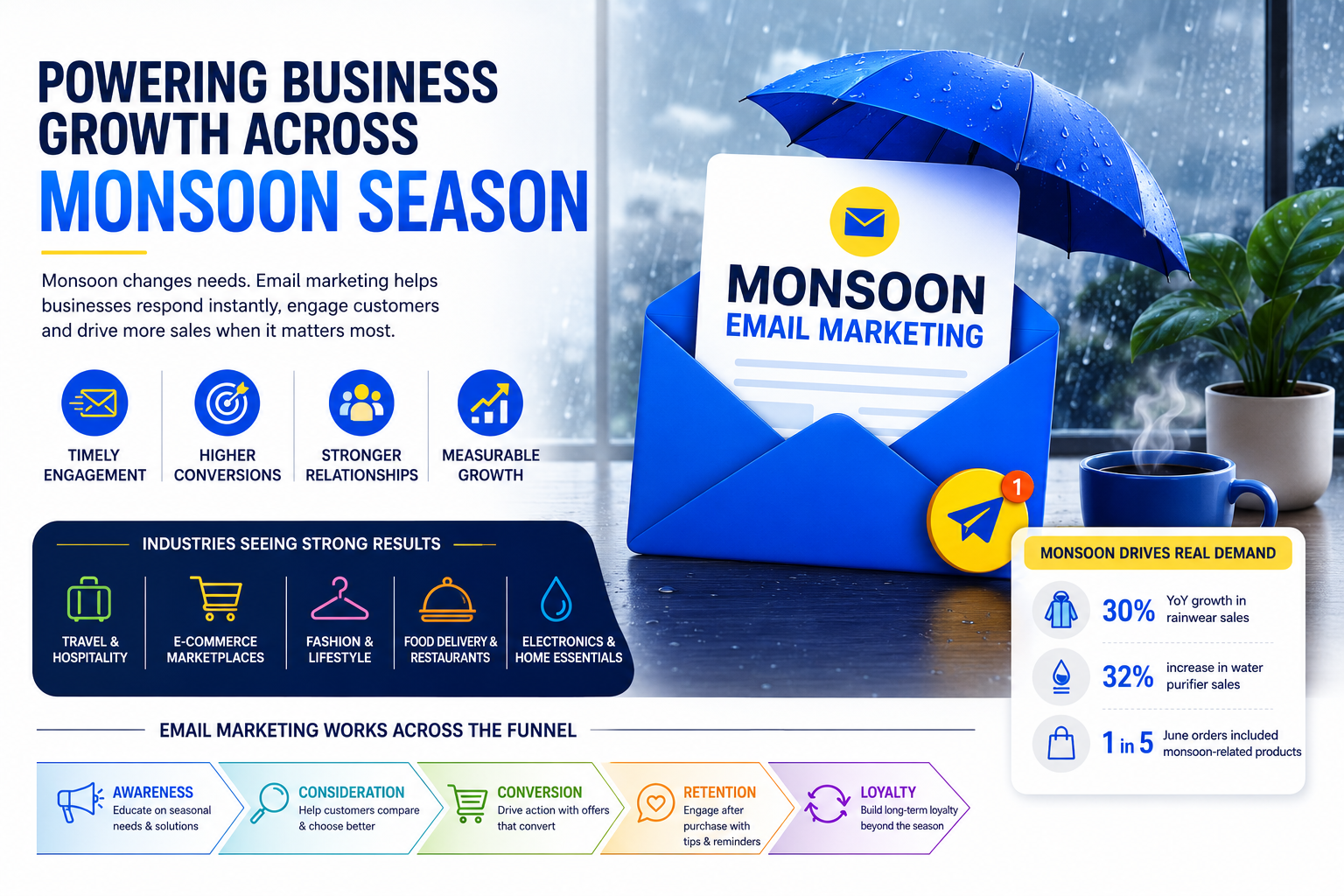
Table Of Contents
- Why the Benefits of Monsoon Email Marketing Matter More Than Ever
- Top Industries Driving Strong Results with Rainy Season Email Campaigns
- 11 Proven Benefits of Monsoon Email Marketing (with Real Industry Examples)
- Industry examples showing the benefits of monsoon email marketing in action
- How to Maximize the Benefits of Monsoon Email Marketing with Winning Campaign Strategies
- Pros and cons of monsoon email marketing
- Monsoon Email Marketing Templates, Funnel Strategy, and Expert Answers
- How monsoon email marketing supports awareness, consideration, conversion, and retention
- Conclusion
- FAQs
These conclusions come from verified revenue results, not assumed outcomes. Strategic audience segmentation combined with timely email outreach allows marketers to capitalize on evolving buying patterns ahead of generic seasonal advertising. If that's your market, this guide is built for you. What follows draws on real, sourced monsoon commerce data and established email marketing principles - not invented case studies.
The biggest mistake brands make during the rainy season is relying on a one-size-fits-all approach. They launch one campaign, email everyone at once, and consider the job finished. As rainfall alters how people make buying decisions, email provides the accuracy and speed needed to engage customers the moment demand changes.
Why the Benefits of Monsoon Email Marketing Matter More Than Ever
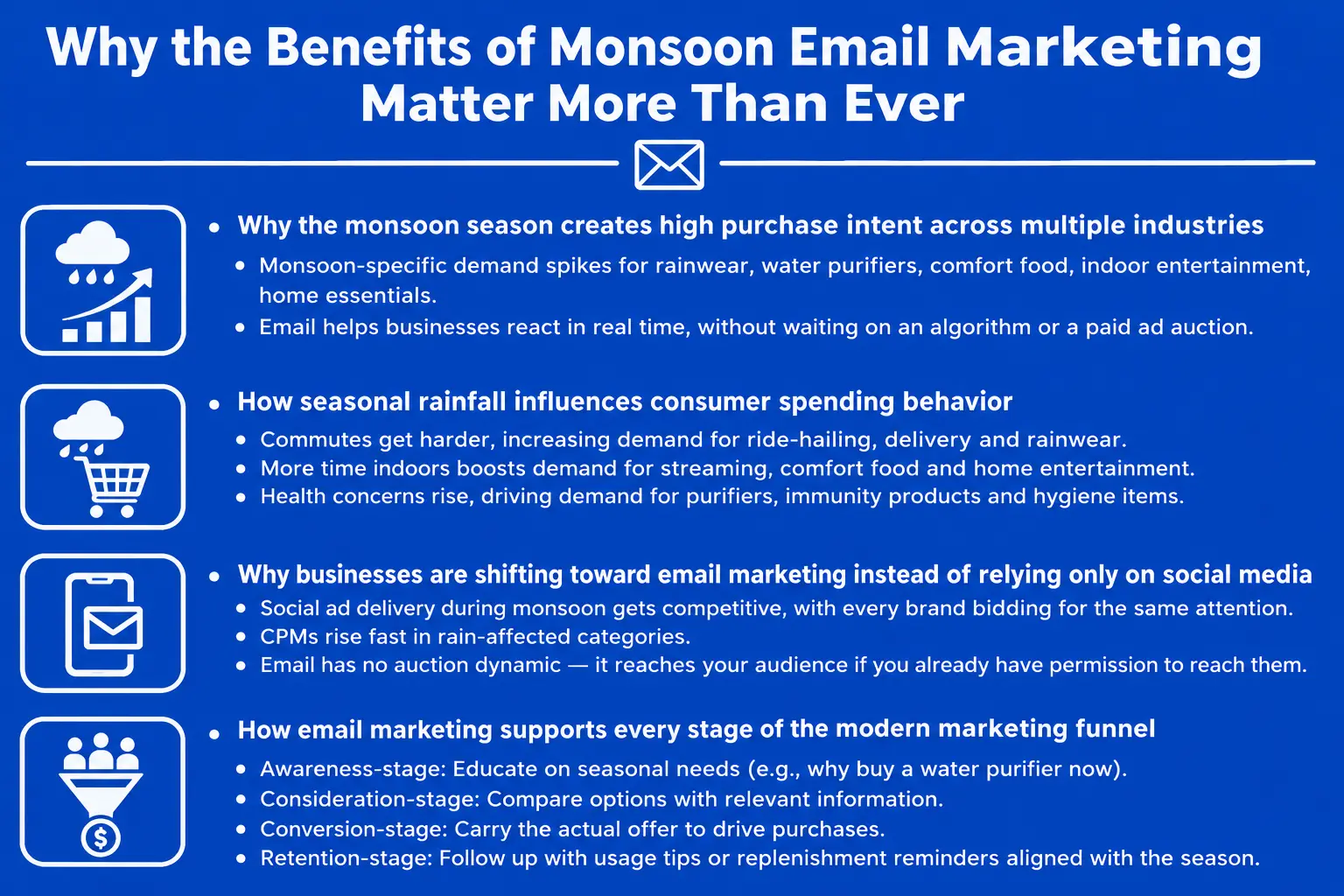
Monsoon creates sudden, category-specific demand spikes - rainwear, water purifiers, comfort food, indoor entertainment, home essentials - and email is the only major channel that lets a business react to that shift in near real time, without waiting on an algorithm or a paid ad auction.
Why the monsoon season creates high purchase intent across multiple industries
The findings here are significantly more reliable than the usual seasonal marketing discussions. According to reporting on 2025 monsoon commerce trends, Flipkart Minutes said one in five June orders included a monsoon-related product, Amazon India reported nearly 30% year-on-year growth in rainwear sales, and Croma reported a 32% increase in water-purifier sales during the rainy season (Source: BestMediaInfo, "How monsoon marketing has evolved from an advertising theme to a commerce trigger," 2026). That's more than brand awareness - it's a measurable shift in customer buying behaviour concentrated into a specific seasonal window.
How seasonal rainfall influences consumer spending behavior
Rain restructures daily routines in ways that ripple into purchase decisions. Commutes get harder, which increases demand for ride-hailing, delivery, and rainwear. Time indoors increases, which lifts demand for streaming, comfort food, and home entertainment. Health concerns rise, pushing purifiers, immunity products, and hygiene items. Concrete sales figures back these observations, not hypothetical expectations. Strategic audience segmentation combined with timely email outreach allows marketers to capitalize on evolving buying patterns ahead of generic seasonal advertising.
Why businesses are shifting toward email marketing instead of relying only on social media
Social ad delivery during monsoon gets genuinely competitive - every brand in a rain-affected category is bidding for the same attention in the same short window, which drives CPMs up fast. Email doesn't have that auction dynamic. If you already have permission to reach a customer, a monsoon-relevant email reaches them regardless of how crowded the paid social feed gets that week.
How email marketing supports every stage of the modern marketing funnel
Monsoon email isn't just a discount blast - it can do real funnel work if it's built that way. Awareness-stage emails can educate on seasonal needs (why now is the time to buy a water purifier). Consideration-stage emails can compare options. Conversion-stage emails can carry the actual offer. Retention-stage emails can follow up post-purchase with usage tips or replenishment reminders tied to how long the season typically runs. Brands often concentrate only on closing conversions, yet the real competitive advantage lies in the neglected phases leading up to them.
Top Industries Driving Strong Results with Rainy Season Email Campaigns
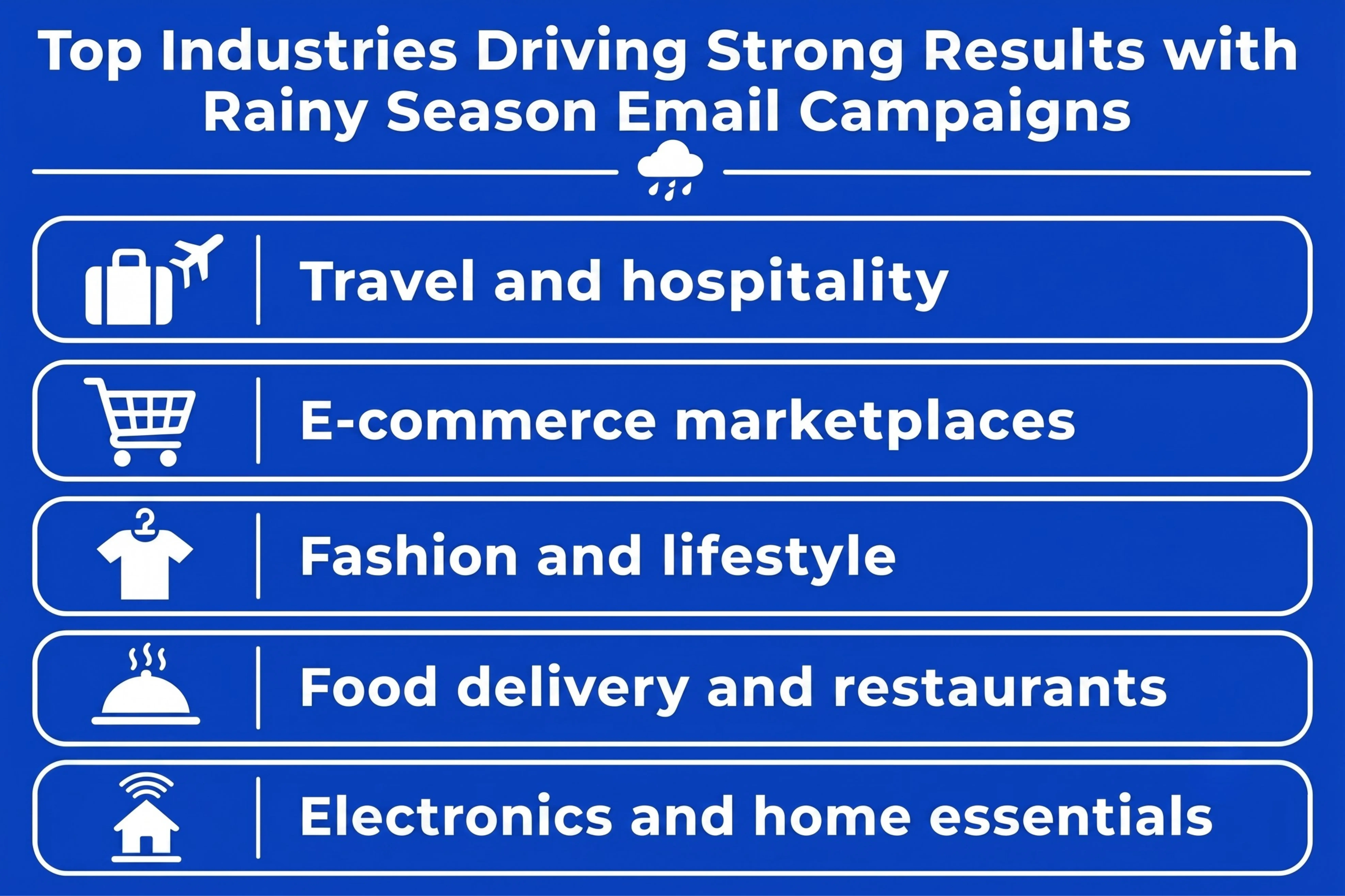
Travel and hospitality
Instead of treating the monsoon as an off-peak period, travel businesses can capitalize on rising interest in nature-focused vacations. As travelers search for lush landscapes and quick holiday breaks, promotional emails highlighting seasonal offers help accommodations improve occupancy during quieter months.
E-commerce marketplaces
Broad marketplaces benefit from monsoon demand spanning dozens of categories at once - rainwear, footwear, home goods, electronics - making segmented monsoon email one of the highest-leverage campaigns of the quarter for a platform with diverse inventory.
Fashion and lifestyle
Rain-appropriate footwear, quick-dry fabrics, and layering pieces see genuine seasonal demand shifts, and fashion brands with strong purchase-history data can target exactly the customers likely to need a seasonal wardrobe refresh.
Food delivery and restaurants
The appetite for comfort dishes grows significantly during the rainy season, making it a proven pattern in India’s seasonal advertising landscape, where brands like Maggi use rain-based campaigns to highlight hot noodle cravings.
Electronics and home essentials
Water purifiers, dehumidifiers, and power backup products see real seasonal spikes tied directly to monsoon conditions - Croma's reported 32% increase in water-purifier sales during the rainy season is a direct example of this category shift (Source: BestMediaInfo, 2026).
11 Proven Benefits of Monsoon Email Marketing (with Real Industry Examples)
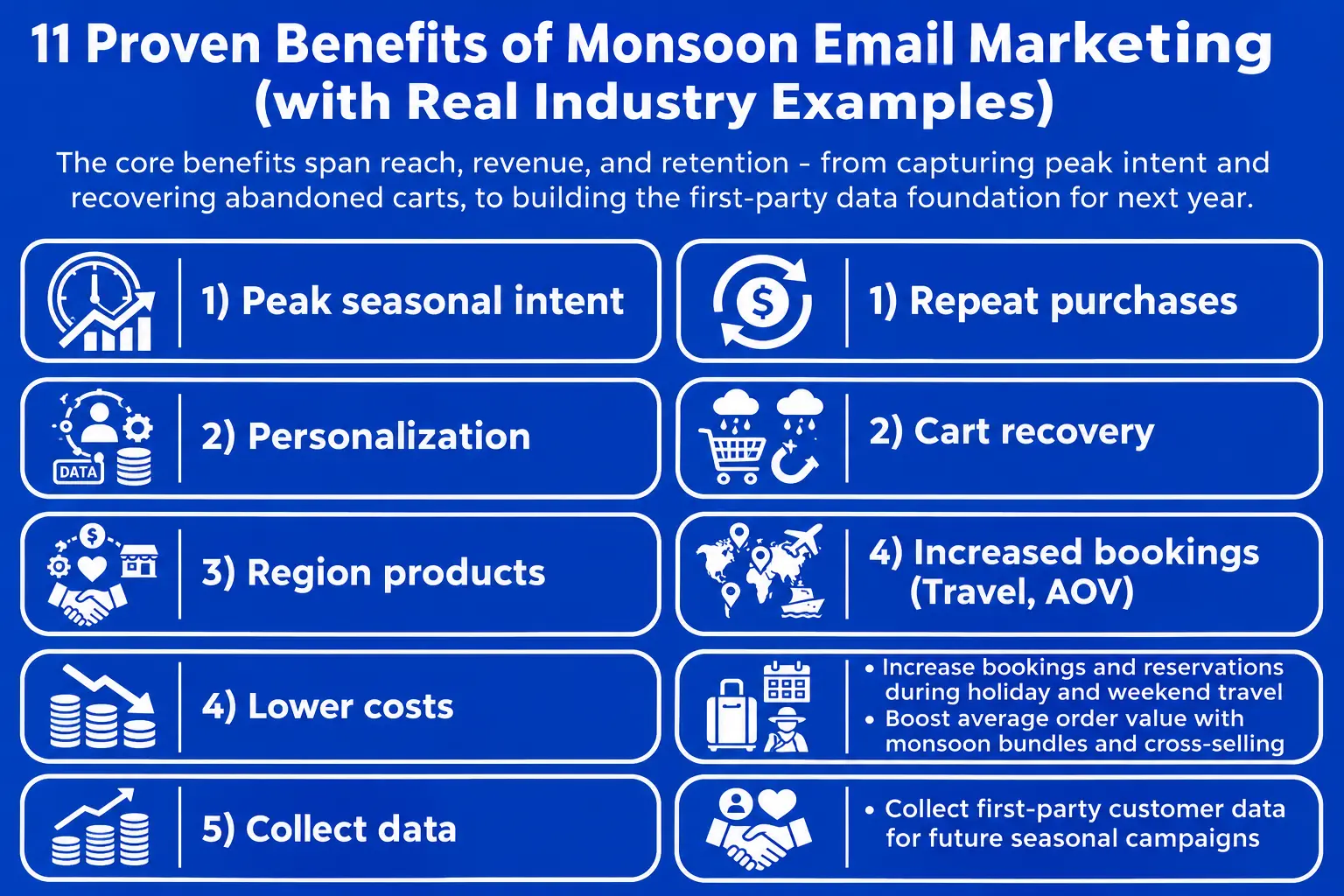
The core benefits of monsoon email marketing span reach, revenue, and retention - from capturing peak seasonal intent and recovering weather-driven cart abandonment, to building the first-party data foundation for next year's campaign before this season even ends.
Benefit 1: Reach customers when seasonal buying intent is at its highest
Timing an email to land as monsoon-related search and purchase behavior is climbing - not after it's already peaked - is the single biggest lever in seasonal email marketing. The category data cited earlier shows this window is real and measurable, not assumed.
Benefit 2: Increase repeat purchases with timely monsoon offers
Customers who bought rain-related products last monsoon are a highly qualified segment for this year's campaign - they've already demonstrated the need exists for them, which makes a well-timed reminder email far more efficient than cold acquisition.
Benefit 3: Improve customer engagement through personalized seasonal campaigns
A monsoon email that reflects a customer's actual location and past purchase category - rather than a generic "monsoon sale" blast - performs better for the same reason personalization outperforms generic sends in any context: it signals relevance immediately.
Benefit 4: Recover abandoned carts with weather-driven reminders
A cart abandoned on a rainwear or purifier product during an active rain event is a strong signal the need is real and immediate - a follow-up reminder timed to that context tends to outperform a standard, delayed abandonment email.
Benefit 5: Build stronger customer trust using valuable seasonal content
Brands that lead with genuinely useful seasonal content - hygiene tips during monsoon, how to prep a home for heavy rain, safe-driving guidance - build more goodwill than brands that only ever show up with a discount code. Paper Boat's long-running #FloatABoat monsoon campaign is a strong example of a brand building emotional, nostalgia-driven seasonal content rather than leading purely with a promotional offer (Source: Digital Scholar, "Best eCommerce Digital Marketing Case Studies in India," 2025).
Benefit 6: Promote region-specific products with audience segmentation
Monsoon intensity and timing varies significantly by region - coastal areas, northeastern states, and drier inland regions all experience different rainfall patterns. Segmenting by geography lets a single campaign send genuinely different offers to genuinely different needs, instead of one generic message forced across an entire list.
Benefit 7: Increase bookings and reservations during holiday and weekend travel
For travel and hospitality brands, monsoon email tied to specific weekend windows or regional holidays converts noticeably better than a generic "book your monsoon getaway" send with no time anchor.
Benefit 8: Boost average order value with monsoon bundles and cross-selling
Bundling naturally-related seasonal items - an umbrella with rain boots, a purifier with filter replacements - gives email a legitimate reason to recommend a higher-value cart than a single-item promotional send would.
Benefit 9: Strengthen customer loyalty using automated lifecycle emails
An automated flow that checks in mid-season with usage tips, and again near the season's end with a "get ready for next year" note, builds a relationship that a single seasonal blast never can.
Benefit 10: Generate measurable ROI with lower marketing costs
Because email doesn't compete in the same paid-auction environment as social ads during the season's most competitive weeks, the cost to reach an already-permissioned customer stays comparatively stable even as paid channels get more expensive during the same window.
Benefit 11: Collect first-party customer data for future seasonal campaigns
Every monsoon campaign - what customers clicked, bought, or ignored - becomes training data for a sharper campaign next season. Brands that treat monsoon as a recurring, improvable system rather than a one-off sale consistently outperform brands that rebuild the campaign from scratch every year.
Industry examples showing the benefits of monsoon email marketing in action
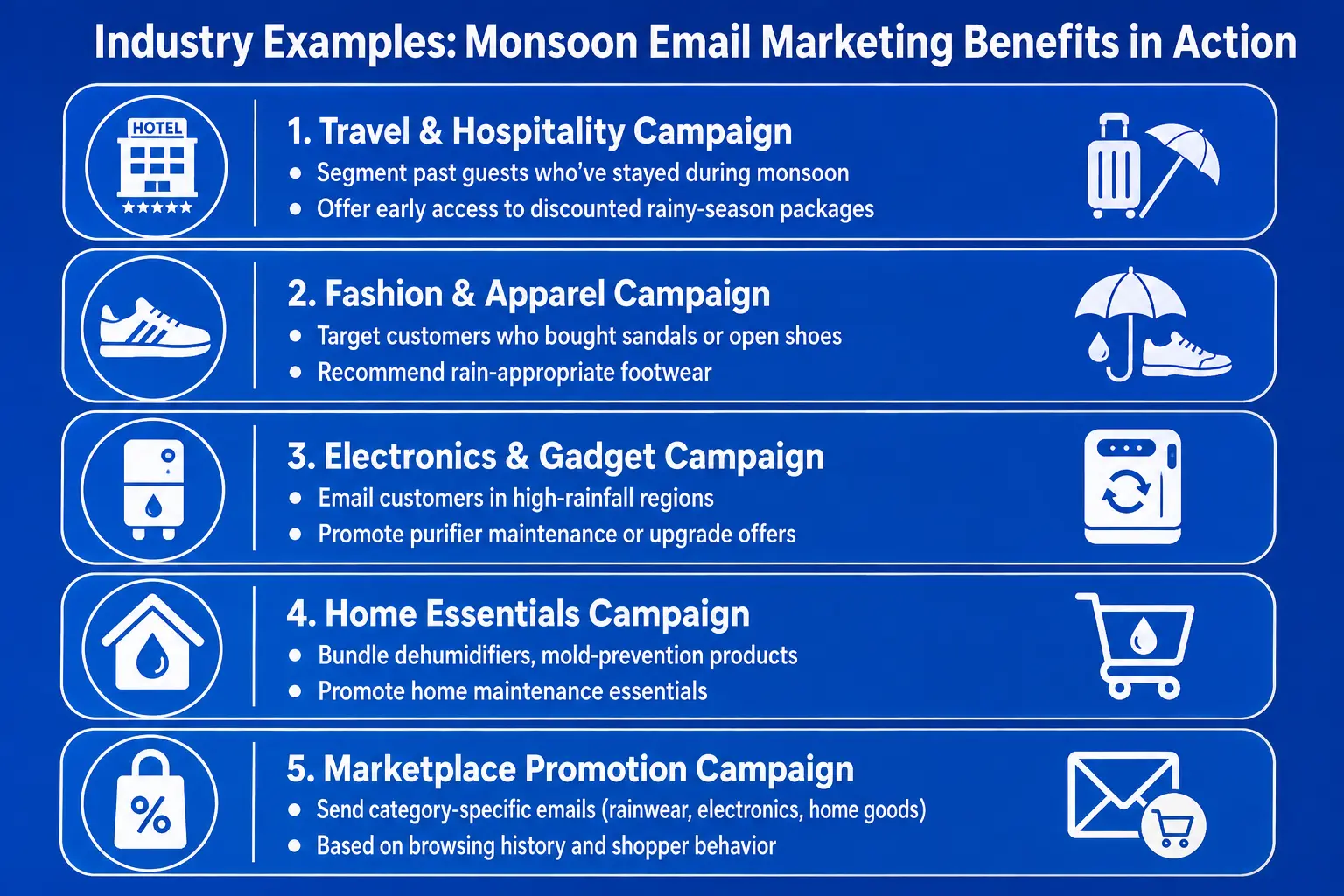
Travel and hospitality campaign example
A domestic hotel chain segmenting past guests by whether they've previously booked a monsoon-season stay, then sending that segment early access to discounted rainy-season packages before the general list, is a practical application of Benefit 1 and Benefit 7 together.
Fashion and apparel campaign example
A footwear brand targeting customers who purchased sandals or open shoes last season with a rain-appropriate footwear recommendation applies segmentation (Benefit 6) directly to a genuine seasonal need.
Electronics and gadget campaign example
Given Croma's documented 32% rise in water-purifier sales during monsoon (Source: BestMediaInfo, 2026), an electronics retailer emailing customers in high-rainfall regions about purifier maintenance or upgrade offers is a direct, data-backed application of regional segmentation.
Home essentials campaign example
A bundle email combining dehumidifiers, mold-prevention products, and home maintenance items reflects Benefit 8's cross-selling logic applied to a category with genuine seasonal urgency.
Marketplace promotion example
A broad marketplace sending category-specific monsoon emails - one version for rainwear shoppers, another for electronics shoppers, another for home goods shoppers - based on browsing history reflects Flipkart Minutes' documented pattern of one in five June orders including a monsoon product (Source: BestMediaInfo, 2026), applied at the segmentation level rather than as a single blanket sale email.
How to Maximize the Benefits of Monsoon Email Marketing with Winning Campaign Strategies
The highest-converting monsoon campaigns start segmentation and list-building before the season peaks, use regionally and behaviorally targeted content instead of one generic sale email, and measure success by conversion and revenue per send rather than raw open rate.
Best practices for creating high-converting monsoon email campaigns
Start planning at least four to six weeks before the season typically begins in your target region, so the welcome and early-access sequences are ready before demand peaks rather than reacting after it. Build segments by region and past seasonal purchase behavior before writing a single subject line - the targeting decision matters more than the copy.
Smart Timing Strategies for High-Performing Monsoon Email Campaigns
There's no universal monsoon send-time formula - regional rainfall timing varies too much for one answer to apply everywhere. What performs consistently is aligning send timing with the actual onset of rain in a given region rather than a fixed calendar date, since interest measurably climbs once rain actually starts rather than when it's merely forecast.
Subject line strategies that improve opens during the rainy season
Specific, seasonally grounded subject lines ("Your city's first rain is coming - here's what to grab before it does") tend to outperform generic ones ("Monsoon Sale is Here!") because they signal genuine relevance to a real, current condition rather than a recycled seasonal template.
Personalization techniques that increase clicks and conversions
Layer three signals where possible: region (rainfall timing and intensity), past purchase category, and current browsing behavior. A customer in a high-rainfall coastal city who previously bought an umbrella is a fundamentally different segment than a customer in a drier inland region who's never purchased a rain-related item - treating them identically wastes the targeting opportunity entirely.
Segmentation strategies for travel, hospitality, and e-commerce audiences
For travel and hospitality, segment by past booking behavior and travel-distance preference. For e-commerce, segment by product category history and regional rainfall exposure. In both cases, a two- or three-segment structure built early outperforms a single blanket send, even if the segments aren't perfectly refined yet.
Campaign ideas for limited-time monsoon promotions
Early-bird access for past seasonal customers before the general list, weekend-specific travel offers tied to actual forecasted rain, and bundle promotions combining complementary seasonal products all give a monsoon campaign an authentic buying trigger that extends past ordinary percentage-based savings.
Common mistakes that reduce monsoon campaign performance
Sending the same generic "monsoon sale" email to the entire list regardless of region is the most common and costly mistake, since it wastes the one advantage seasonal segmentation actually offers. Launching too late - after the season has already peaked in a given region - is a close second. A third common mistake is measuring success purely on open rate, which says nothing about whether the seasonal targeting actually drove revenue.
Pros and cons of monsoon email marketing
Advantages businesses should leverage
A defined, predictable annual window with measurable demand shifts (as shown in the Flipkart, Amazon, and Croma data cited earlier), lower competition for inbox attention compared to the paid social auction during the same period, and a natural, recurring opportunity to deepen first-party data year over year.
Challenges marketers should prepare for
Rainfall timing varies year to year and by region, which makes rigid calendar-based planning less reliable than planning that can adapt to actual weather onset. Campaigns also compete against a genuinely crowded seasonal advertising landscape across other channels, even if email itself avoids the auction dynamic directly.
KPIs and metrics to measure monsoon campaign success
Track click-to-open rate and conversion rate by segment (not in aggregate) so you can see which regional or behavioral segment actually drove the season's revenue. Revenue per email and average order value on bundled sends are more meaningful success indicators than raw open rate, particularly given how unreliable open-rate data has become industry-wide since Mail Privacy Protection from Apple started loading email images automatically.
Monsoon Email Marketing Templates, Funnel Strategy, and Expert Answers
Below are structural templates for the core monsoon email types, followed by a funnel-stage breakdown showing how a monsoon campaign can support awareness through retention rather than a single promotional blast.
Monsoon promotional email sample for travel and hospitality businesses
Subject: Your city's first rain, our best monsoon rates
Structure: Weather-relevant hook → the specific package or offer → a real, time-bound deadline → single CTA to book.
Seasonal Rain Sale Email Templates for E-commerce
Subject: Before the next downpour: what your cart is missing
Structure: Season-specific relevance → Highlight 2–3 products aligned with previous views or purchases → finish with one straightforward CTA.
Monsoon seasonal discount email sample for fashion brands
Subject: Rain-ready footwear, 20% off through the weekend
Structure: Category-specific offer → why it's relevant now (seasonal framing, not generic sale language) → CTA.
Monsoon customer re-engagement email sample
Subject: Last monsoon, you grabbed [product] - still need it?
Structure: Reference the specific past purchase → acknowledge the season's return → low-friction reorder or upgrade CTA.
Monsoon loyalty and repeat purchase email sample
Subject: A quick monsoon tip, plus something for you
Structure: Genuinely useful seasonal content first → soft transition into a loyalty offer or repeat-purchase reminder → single CTA.
How monsoon email marketing supports awareness, consideration, conversion, and retention
Top-of-funnel email strategy
Educational content about what to expect this season - regional rainfall outlook, general prep guidance - introduces the brand's relevance without asking for a sale yet.
Middle-of-funnel nurturing strategy
Comparison-style content (which purifier fits which household size, which travel package fits which trip length) builds the trust needed before a conversion-focused send lands well.
Bottom-of-funnel conversion strategy
Time-bound offers, bundle promotions, and cart-recovery emails tied to active seasonal urgency carry the actual conversion push.
Post-purchase retention strategy
Usage tips, replenishment reminders, and an end-of-season "thank you, see you next year" touch keep the relationship active well past the initial sale - this is the stage most monsoon campaigns skip entirely, and it's exactly where next year's Benefit 11 (first-party data advantage) gets built.
Conclusion
The benefits of monsoon email marketing go beyond seasonal promotions. With the right audience segmentation, personalization, and timely campaigns, businesses can boost engagement, increase conversions, and build long-term customer loyalty. Whether you operate in e-commerce, travel, hospitality, or retail, aligning your email strategy with changing monsoon buying behavior helps maximize ROI while strengthening customer relationships. Start planning early, track meaningful performance metrics, and use data-driven email campaigns to turn the rainy season into one of your most profitable marketing opportunities.
FAQs
1. Is monsoon email marketing effective for small businesses?
Answer: Yes - the segmentation and targeting principles that make it effective don't require a large list, just genuine relevance to a regional, seasonal need. A small business with a well-segmented local list can outperform a large brand sending one generic blast.
2. Which industries benefit the most from monsoon campaigns?
Answer: Based on documented 2025 category data, rainwear, water purifiers, food delivery, and travel/hospitality show the clearest measurable demand shifts (Source: BestMediaInfo, 2026), though nearly any business with a genuine seasonal brands across different sectors can gain visibility from the lower email traffic and reduced competition within inboxes at this time.
3. How early should businesses launch monsoon email campaigns?
Answer: Four to six weeks of preparation before the season's typical onset in your target region gives enough time to build segments and sequence content, but the actual send date should follow local rainfall patterns rather than a fixed calendar wherever possible.
4. What types of offers perform best during the rainy season?
Answer: Thoughtfully bundled seasonal selections, advance offers for loyal seasonal buyers, and flash promotions inspired by current weather trends generally outperform ordinary discount campaigns that ignore seasonal demand and local market conditions.
5. How can businesses improve conversions during monsoon promotions?
Answer: Segment by region and past purchase behavior before writing any copy, lead with genuine seasonal relevance rather than a recycled sale template, and time sends to actual rainfall onset rather than a fixed calendar date.
6. Which email metrics should marketers monitor during seasonal campaigns?
Answer: Conversion rate and revenue per send, broken out by segment, matter more than aggregate open rate - segment-level data is what actually shows which targeting decisions worked and which didn't.
Tags: Monsoon Email Marketing, Seasonal Email Marketing, Email Marketing for Seasonal Sales, Benefits of monsoon email marketing, Personalized monsoon email campaigns, monsoon campaign ideas in India, monsoon digital marketing.
Table Of Contents
- Why the Benefits of Monsoon Email Marketing Matter More Than Ever
- Top Industries Driving Strong Results with Rainy Season Email Campaigns
- 11 Proven Benefits of Monsoon Email Marketing (with Real Industry Examples)
- Industry examples showing the benefits of monsoon email marketing in action
- How to Maximize the Benefits of Monsoon Email Marketing with Winning Campaign Strategies
- Pros and cons of monsoon email marketing
- Monsoon Email Marketing Templates, Funnel Strategy, and Expert Answers
- How monsoon email marketing supports awareness, consideration, conversion, and retention
- Conclusion
- FAQs