
50 Email Marketing Best Practices

Let's start with one simple question: Why is email marketing entering 2026 as the most cost-efficient marketing channel for most businesses?
Omnisend's 2026 benchmark report puts email's average ROI at roughly $42 for every $1 spent, and its own merchant data shows brands running structured automation flows pulling in closer to $79 per $1 on paid plans - almost double the broader industry figure. For context, Digital Applied's 2026 channel comparison places paid search at roughly $2 per $1 spent and paid social at around $2.80, which is why email keeps winning the budget argument even as reported figures vary by measurement method. This guide walks through why adoption is accelerating, the honest trade-offs of the channel, and 50 specific, actionable best practices you can apply this quarter - plus ready-to-adapt email samples and answers to the questions marketers ask most.
If there's one email marketing best practice to focus on in 2026, it's combining permission-based list building with behavioral segmentation and AI-assisted personalization. This combination consistently drives the biggest improvements in opens, clicks, and revenue per send.
Why Businesses Are Embracing Email Marketing in 2026
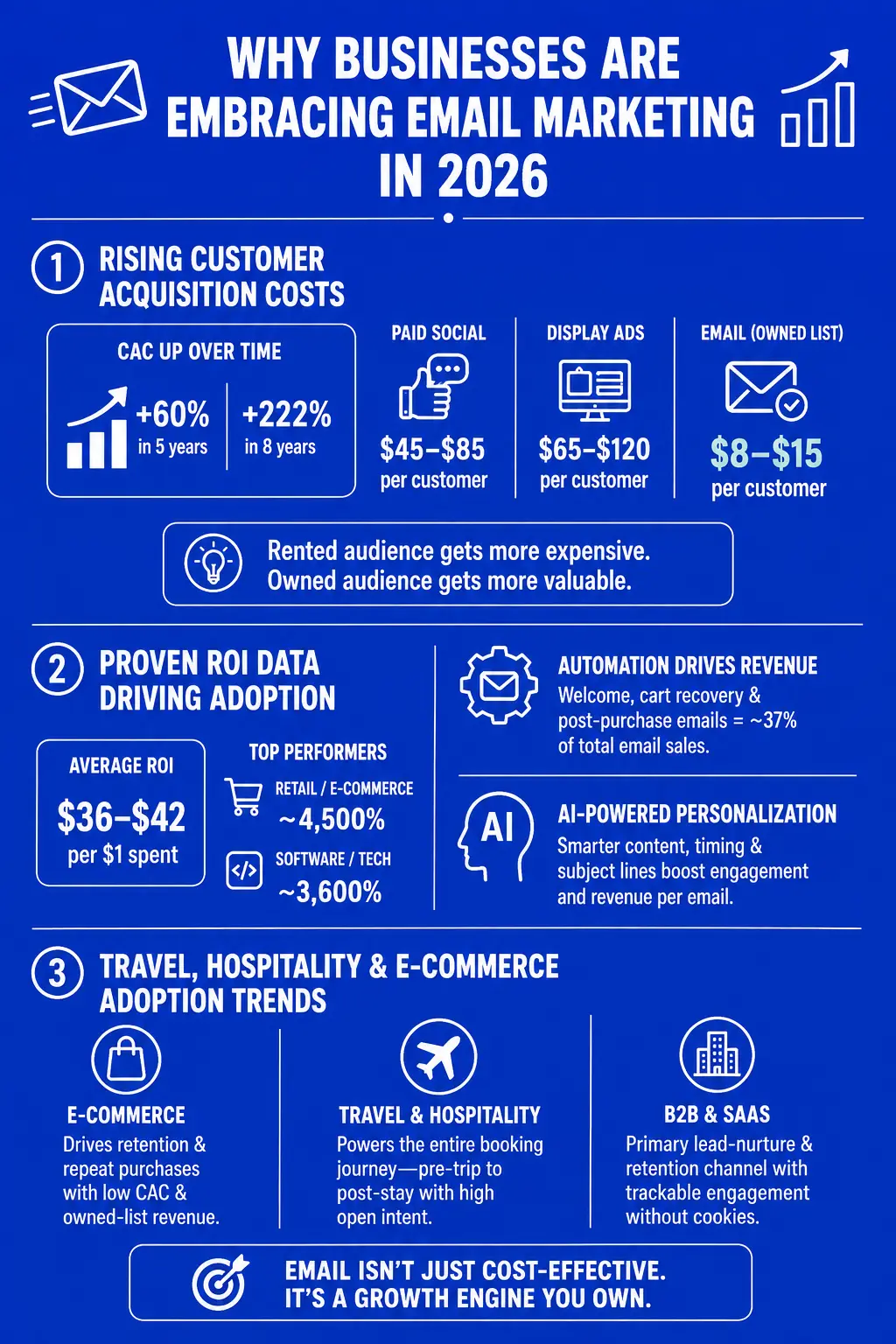
In the era of expensive digital marketing, email isn't growing because it's novel - it's growing because the alternative channels have gotten more expensive and less predictable. Marketers are reallocating budget toward the channel they own outright: their subscriber list.
Rising Customer Acquisition Costs Across Channels
Customer acquisition cost (CAC) has become the metric forcing this shift. GTM 8020 and GrowSurf both cite CAC climbing roughly 60% over the past five years and an estimated 222% over the past eight, driven by rising ad auction prices, post-iOS-14 targeting limitations, and more brands competing for the same keywords and audiences. Paid social and display advertising have absorbed the brunt of this inflation. Take a mid-market e-commerce brand as a concrete example: EasyAppsEcom's 2026 Shopify benchmarks show a typical store paying $45–$85 per customer through paid social and as much as $65–$120 through display ads, while the same store's email channel - built on its own list - costs closer to $8–$15 per acquired customer. That five-to-tenfold gap is precisely why finance and marketing leaders are pushing harder on owned-channel infrastructure rather than continuing to bid up scarce paid inventory.
The logic is surprisingly simple: a rented audience (ad platforms) gets more expensive every year you rely on it, while an owned audience (your list) gets more valuable every year you nurture it.
Proven ROI Data Driving Adoption
The ROI case for email has been remarkably stable for years, and 2026 data reinforces it. Estimates still vary by source and methodology - Omnisend and Digital Applied cite roughly $36–$42 per $1 spent as the broad industry average, while EmailMonday's sector breakdown puts retail, e-commerce, and consumer goods brands closer to a 4,500% return, ahead of software and technology at around 3,600%. Automation compounds this advantage further. Omnisend's data demonstrates how powerful automated email marketing can be. In 2024, welcome sequences, cart recovery emails, and post-purchase follow-ups represented only a tiny share of overall sends, yet they produced nearly 37% of total email sales. Emails customized around user activity generated higher engagement and stronger commercial performance than fixed campaign schedules.
AI-assisted personalization is the other major driver behind 2026's ROI figures. Companies applying AI to customize email headlines, schedule messages intelligently, and adapt content for each recipient frequently see improved engagement and increased earnings per email sent. This is exactly why AI-enabled hyperpersonalization has become a leading focus across almost all 2026 email marketing trend analyses.
Travel, Hospitality, and E-commerce Adoption Trends
Among all industries in 2026, three have made email a core driver of their growth strategy:
-
E-commerce brands lean on email for post-purchase retention and repeat-purchase automation because it remains one of the lowest-CAC channels available, and because owned-list revenue is far less vulnerable to platform policy or algorithm changes than paid social traffic.
-
Travel and hospitality brands use email for the entire booking lifecycle - pre-trip anticipation content, booking confirmations, itinerary reminders, and post-stay review requests - because these moments have naturally high open intent and lend themselves well to timed, automated sequences.
-
B2B and SaaS companies increasingly treat email as their primary lead-nurture and retention engine, since it is one of the few channels where a prospect's engagement history (opens, clicks, content downloads) can be tracked and acted on without third-party cookie dependency.
Pros and Cons of Email Marketing
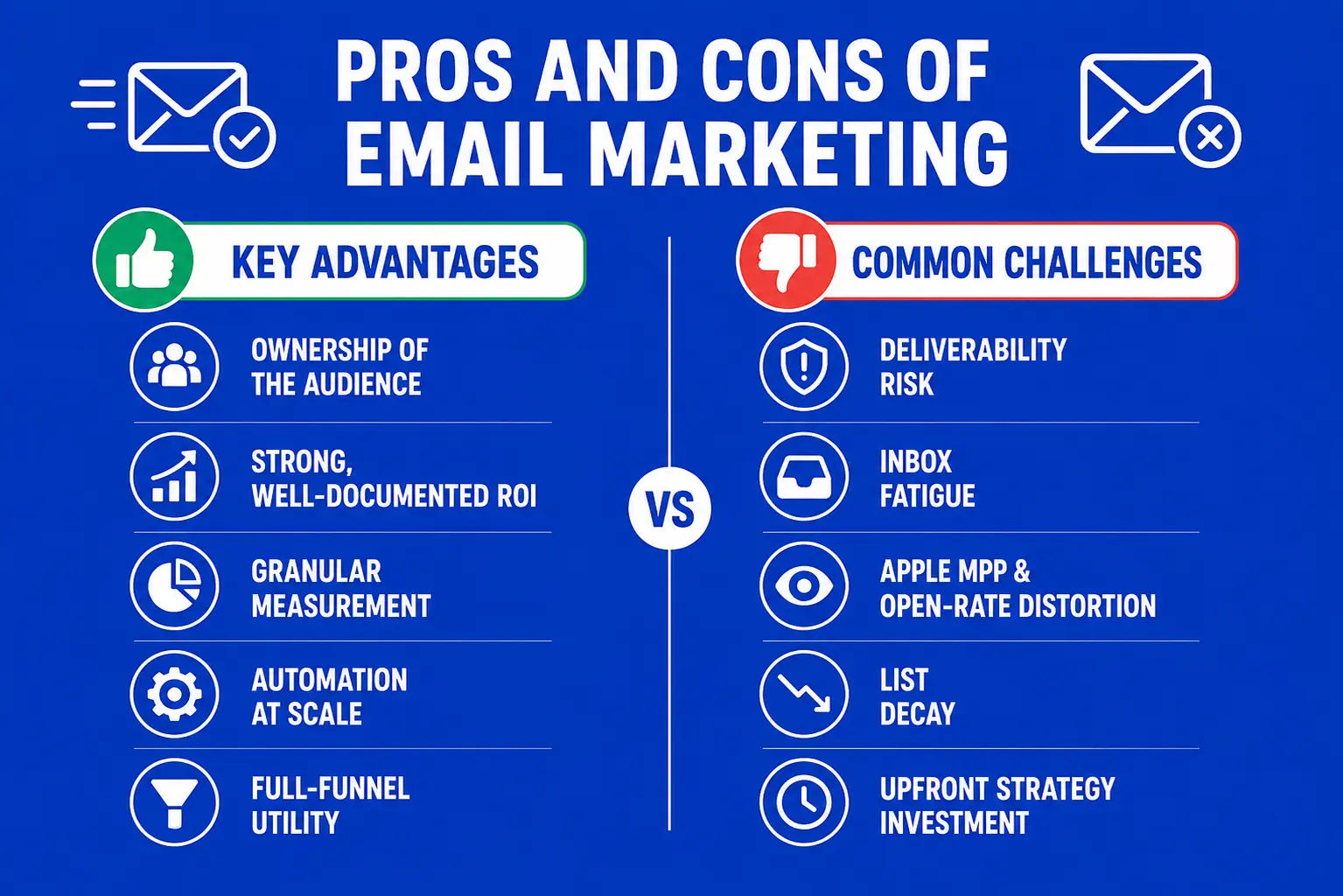
No single platform delivers the best outcome in every situation, so smart planning weighs drawbacks alongside benefits.
Key Advantages Businesses Gain From Email
-
Ownership of the audience. Unlike followers on a social platform, your list isn't subject to a sudden algorithm change or account suspension.
-
Strong, well-documented ROI. Recognized for generating some of the strongest digital marketing ROI.
-
Granular measurement. Opens, clicks, conversions, and revenue per send are directly attributable in a way paid social often isn't post-privacy-changes.
-
Automation at scale. Greeting sequences, abandoned basket reminders, and retention workflows keep running automatically without constant manual management.
-
Full-funnel utility. It helps attract new audiences, nurture interested prospects, convert ready buyers, and maintain lasting customer relationships.
Common Challenges and Limitations to Address
-
Deliverability risk. Poor list hygiene, high bounce rates, or spam complaints can land a domain in spam folders, undermining every other tactic on this list.
-
Inbox fatigue. Daily inbox competition is intense, so brands succeed by sharing content that truly matters instead of relying on higher sending volume.
-
Apple Mail Privacy Protection and open-rate distortion. Automatic pixel loading inflates reported open rates by an estimated 4–8 percentage points, meaning opens alone are an increasingly unreliable success metric - click-through and conversion rates matter more than they used to.
-
List decay. Email lists naturally erode a few percentage points a year as people change addresses or disengage, so growth has to outpace churn.
-
Upfront strategy investment. Segmentation, automation flows, and testing infrastructure take real setup time before the ROI shows up.
Core Email Marketing Best Practices for 2026
The following table presents an at-a-glance recap of all 50 key practices. Detailed recommendations covering the major categories appear below.
|
# |
Best Practice |
# |
Best Practice |
|
1 |
Use double opt-in for every new subscriber |
26 |
Send re-engagement campaigns before suppressing cold contacts |
|
2 |
Never buy or rent email lists |
27 |
Segment by purchase history, not just demographics |
|
3 |
Make unsubscribing one click, not a maze |
28 |
Use progressive profiling to enrich subscriber data over time |
|
4 |
Set clear expectations at signup (frequency, content type) |
29 |
Deliver emails at each user's ideal time |
|
5 |
Warm up new sending domains gradually |
30 |
Use plain-text-style templates for higher deliverability on some sends |
|
6 |
Authenticate with SPF, DKIM, and DMARC |
31 |
Keep image-to-text ratio balanced for spam filter compliance |
|
7 |
Monitor sender reputation and blocklist status regularly |
32 |
Write relevant image descriptions for every graphic. |
|
8 |
Regularly remove inactive or invalid email contacts. |
33 |
Use accessible color contrast and font sizing |
|
9 |
Segment new subscribers by acquisition source |
34 |
Limit subject lines to around 50 characters for mobile. |
|
10 |
Create a genuine welcome journey instead of sending just one email. |
35 |
Lead with the benefit in preview text instead of echoing the subject line. |
|
11 |
Personalize beyond first-name merge tags |
36 |
Compare multiple subject lines using a representative audience before launch. |
|
12 |
Use behavioral triggers (browse, cart, purchase) |
37 |
Avoid spam-trigger words and excessive punctuation |
|
13 |
Build dynamic content blocks for different segments |
38 |
Use one clear, prominent call-to-action per email |
|
14 |
Apply RFM (recency, frequency, monetary) segmentation |
39 |
Keep paragraphs short and scannable on mobile |
|
15 |
Personalize send time to individual open patterns |
40 |
Test single-column layouts for small-screen readability |
|
16 |
Let AI create the initial copy and subject options, but always review and personalize before delivery. |
41 |
Reduce image sizes to ensure faster loading across mobile data connections. |
|
17 |
Categorize assets by audience intent |
42 |
Place a clear removal link inside every email you deliver. |
|
18 |
Build automated welcome, abandoned-cart, and post-purchase flows |
43 |
Track click-to-open rate, not just open rate |
|
19 |
Use win-back sequences for lapsed customers |
44 |
Measure revenue from each email, not only the campaign. |
|
20 |
Align email cadence to industry norms and audience tolerance |
45 |
Monitor unsubscribe and spam-complaint rates per send |
|
21 |
Test frequency caps to avoid list fatigue |
46 |
Measure one modification at once. |
|
22 |
Send at data-backed optimal times, then refine with your own data |
47 |
Benchmark performance against your own history, not generic averages |
|
23 |
Avoid Saturday sends for most B2C lists unless tested |
24 |
Use timezone-based sending for geographically spread lists |
|
25 |
Deliver your most valuable campaigns when customer attention reaches its highest level. |
48 |
Review and refresh templates quarterly |
|
49 |
Keep a documented content calendar across teams |
50 |
Audit compliance (CAN-SPAM, GDPR, CASL) at least annually |
Building Permission-Based Subscriber Lists Correctly
A permission-based list means every subscriber actively opted in, understands what they'll receive, and can leave just as easily as they joined.
Buying or scraping lists is one of the fastest ways to damage sender reputation, since recipients who never opted in mark messages as spam at far higher rates. In my experience, successful email programs begin with the first subscription. Understand that effective list building starts with clear signup expectations, covering your email schedule and content themes. Verify each contact through double opt-in, then introduce them with a dedicated welcome series before moving them into regular campaigns. These early steps create healthier lists and improve long-term deliverability.
Personalization and Segmentation Strategies That Convert
A customer’s name can grab attention, but real personalization comes from delivering relevant content, suitable offers, and timely messages based on their actions.
The best results come from organizing subscribers by shopping habits, on-site behavior, engagement freshness, and lifecycle position-not just age or location. Measuring recency, buying frequency, and customer spend through RFM helps businesses identify high-value groups and tailor offers more effectively. In my experience, people respond far better to emails that reflect their preferences and past actions. Personalized campaigns usually outperform mass messaging in engagement and revenue, whereas irrelevant emails gradually weaken customer interest.
Subject Lines and Preview Text Optimization
A weak subject line is often the hidden reason your email campaign fails to earn that crucial first open. The best subject lines quickly tell readers what matters, usually within 50 characters, while the preview should complement the message with useful information not already mentioned.
Every successful email campaign begins with careful testing. Try your subject lines on a small audience first, stay away from words or symbols that may trigger spam filters, and refine AI-created suggestions until they naturally match your brand's personality before launching to everyone. Do not take email marketing lightly; a well-personalized subject line can capture attention and drive more opens than generic messaging.
Mobile-First Design Across Different Screens
By now, most marketers already know that the majority of email opens happen on smartphones. Creating for phone users before any other device is now a critical business strategy.
Responsive Layouts for Every Screen Size
Use single-column layouts, minimum 14px body text, tap-friendly button sizing, and compressed images so the email loads quickly on mobile data connections. Verify your email appears correctly in top email apps, including Apple Mail, Gmail, and Outlook, before launching it across your entire audience.
Best Times to Send Emails
Whenever you're about to launch an email campaign, timing is one of the biggest decisions. Industry performance data for 2026 highlights Tuesday to Thursday, 9–11 a.m., as a top-performing email timeframe. or 3–4 p.m. (local time) tends to perform best. But once you collect enough campaign data, your own audience behavior should become the deciding factor.
Optimal Send Times by Industry
-
Online stores and retailers: Deliver newsletters on Tuesday through Thursday before noon, and reserve promotional or time-sensitive offers for the late afternoon or evening when customers are more likely to make purchases.
-
B2B/SaaS: Tuesday and Wednesday mid-morning, avoiding Monday backlog and Friday wind-down.
-
Travel and hospitality: Send times can skew toward evenings and weekends, when people are more likely to be planning leisure trips rather than at work.
-
Food and beverage: Late afternoon sends, particularly around 5 p.m., often perform well for reservation and takeout-related campaigns.
Email Frequency and Cadence Guidelines
There's no universal frequency that works for every list - but sending too rarely lets subscribers forget why they signed up, while sending too often accelerates unsubscribes and spam complaints. Start with a defined cadence (for example, one to two campaigns a week plus triggered automation), monitor unsubscribe and complaint rates closely for the first several sends, and adjust from there based on engagement trends rather than a fixed industry rule.
How Email Supports the Marketing Funnel
Email is one of the few channels that can support every funnel stage - awareness, consideration, conversion, and retention - using the same core infrastructure.
Awareness Stage Email Content Ideas
Lead magnets, educational newsletters, and top-of-funnel content roundups that introduce your brand's expertise without asking for a sale yet.
Nurturing Leads Through Consideration Stage
Case studies, comparison content, product-education sequences, and social proof designed to move a subscriber from "aware" to "considering" a purchase or demo.
Conversion and Retention Email Tactics
Abandoned-cart sequences, limited-time offers, post-purchase onboarding, and loyalty or win-back campaigns that keep existing customers engaged after the first sale.
Practical Tips for Campaign Creation
Build a documented content calendar shared across marketing, sales, and product teams so campaigns don't collide or duplicate effort. Keep one clear call-to-action per email rather than competing links. Test one variable at a time (subject line, send time, or CTA - not all three at once) so you can actually attribute performance changes to a specific cause. And revisit your templates quarterly; a design that felt fresh a year ago can start to look dated fast.
Email Sample Best Practices for Businesses
Welcome Email Sample for Subscribers
Subject: You're in! Here's what to expect from us
Hi [First Name],
Thanks for joining our list. Here's what you can look forward to: practical tips, occasional product updates, and first access to new launches - roughly once a week, nothing more.
To get started, here are three resources our community finds most useful: [Resource 1] · [Resource 2] · [Resource 3]
Reply anytime - a real person reads every response.
- The [Brand] Team
Promotional Email Sample for Online Stores
Subject: 24 hours only: 20% off your next order
Hi [First Name],
For the next 24 hours, take 20% off site-wide with code SAVE20 at checkout.
[Shop Now - Button]
Offer ends [date/time]. No code needed if you're already logged in - the discount applies automatically at checkout.
Booking Confirmation Email Sample for Travel
Subject: Your booking is confirmed - [Destination], [Dates]
Hi [First Name],
You're all set. Here's a quick summary of your trip:
-
Confirmation number: [XXXXX]
-
Check-in: [Date/Time]
-
Check-out: [Date/Time]
-
Property/Route: [Details]
[View Full Itinerary - Button]
Need to make a change? [Manage Booking Link]. We'll send a pre-arrival reminder a few days before your trip.
Re-engagement Email Sample for Inactive Users
Subject: Still want to hear from us?
Hi [First Name],
We noticed you haven't opened our emails in a while, so we wanted to check in before we adjust how often we reach out.
[Keep Me Subscribed - Button] [Update My Preferences - Link]
If we don't hear back, we'll reduce how often you hear from us going forward - no hard feelings either way.
Conclusion
Email marketing remains one of the most practical ways to build lasting customer relationships, improve conversions, and drive measurable ROI. In 2026, success comes from combining clean lists, smart segmentation, personalization, automation, mobile-first design, and continuous testing. Apply these 50 best practices consistently, measure what works, and refine your strategy around real customer behavior.
FAQs
1. How Often Should Businesses Send Emails
Most businesses do well starting with one to two campaign emails per week, supplemented by automated triggered messages (welcome, cart abandonment, post-purchase), then adjusting frequency up or down based on unsubscribe and engagement trends specific to their own list.
2. What Makes an Email Campaign Successful
A successful campaign combines a permission-based, well-segmented list, a subject line and preview text that earns the open, mobile-first design, a single clear call-to-action, and measurement that goes beyond open rate to include click-to-open rate, conversion rate, and revenue per send.
3. Is Email Marketing Still Effective Today
Yes, and the evidence is stronger than ever. Omnisend's 2026 data puts email's average ROI at around $42 per $1 spent, well ahead of Digital Applied's cited figures for paid search (~$2) and paid social (~$2.80) per $1 spent. On top of that, rising customer acquisition costs on paid channels - Ringly's 2026 e-commerce data shows blended CAC now sitting between $68 and $84 per customer, up sharply from a few years ago - are pushing even more marketing budget toward owned-channel strategies like email.
4. What Are The Best Email Marketing Practices For 2026?
Focus on permission-based list building, behavioral segmentation, AI-assisted personalization, mobile-first design, automation, strong deliverability, and continuous testing. This approach focuses on tracking clicks, actual conversions, revenue generated per email, unsubscribe activity, and spam complaints instead of depending entirely on open-rate performance.
5. What Are Some Email Marketing Best Practice Examples?
Common examples include automated welcome journeys, abandoned-cart emails, post-purchase follow-ups, personalized product recommendations, re-engagement campaigns, and behavior-based emails. These approaches help businesses deliver relevant messages based on subscriber actions and lifecycle stages.
6. What Are The Best B2B Email Marketing Practices?
B2B businesses should segment leads by engagement and lifecycle stage, personalize content based on prospect behavior, use lead-nurturing sequences, and provide useful educational content such as case studies and product comparisons. Blaming is easy, but there are several factors to consider beyond open rates, including clicks, conversions, revenue, unsubscribes, and spam complaints.
7. How Can Businesses Improve Email Deliverability?
Use permission-based lists, avoid purchased contacts, authenticate your domain with SPF, DKIM, and DMARC, remove inactive or invalid contacts regularly, monitor sender reputation, and make unsubscribing easy. Maintaining good list hygiene is essential for keeping emails out of spam folders.
8. How Can AI Improve Email Marketing Results?
AI can help create initial subject-line and copy variations, personalize content, identify suitable send times, and support audience segmentation. However, AI-generated content should always be reviewed and adapted to the brand's voice before sending.
Tags: Email marketing frequency best practices, B2b email best practices, Best practices for email marketing, Advanced email marketing, Email marketing design best practices, Email marketing subject line best practices
Sources: DemandSage, "89 Email Marketing Statistics Of 2026", Omnisend, "Email Marketing ROI: 2026 Benchmarks + Free Calculator", DigitalApplied, "Email Marketing Statistics 2026: 200+ Essential Data", ClickMinded, "Email Marketing Statistics 2026 by Source, Benchmark, and Use Case", Designmodo, "60+ Email Marketing ROI Statistics For 2026", MailerLite, "The Best Time to Send Email in 2026 (Statistical Analysis)", Sender.net, "Best Time to Send Emails for Higher ROI 2026", Attentive, "Best Times to Send SMS & Email Marketing in 2026", UM, "Best Time to Send Emails 2026", Salesforce, "The Best Time To Send Marketing Emails (2026)", Focus Digital, "Customer Acquisition Cost Trends: 2026 Report", Ringly, "45 Ecommerce Customer Acquisition Cost Statistics for 2026", EasyAppsEcom, "Shopify Customer Acquisition Cost Benchmarks 2026", GTM 8020, "38 Customer Acquisition Cost Statistics for B2B SaaS in 2026", GrowSurf, "Customer Acquisition Cost Stats (2026)"